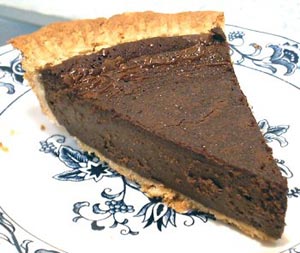
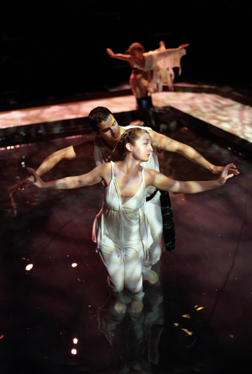
Chocolate Pie: Fudge in a Crust

Photo by bellasavvy.net
Chocolate pie is an emotional subject.  This was my sister Juanita’s favorite dessert years ago.  She had married and moved away, living everywhere from Hawaii to Germany with her Army-officer husband.  Every time she came to visit with her young family, our mother would make a chocolate pie to her specifications–no meringue, the traditional family recipe, no variations.  Juanita would cut a sliver, “just to taste it,” and walk away from it.  Put down that knife!  In no time, another sliver would be gone, and another, and another, until someone else cut a slice in self-defense.

I got Mother’s recipes after she died (see “Home Cooking,” April 14, 2011).  The chocolate pie recipe lacked a lot of information, like oven temperature and how long to bake.  I canvassed the family, consulted other recipes, and experimented a bit.  Here’s the result.  This is not like chocolate pudding pie, or the stuff you get in diners.  It’s very easy, and very chocolate.  I highly recommend it when you’re feeling down and can’t deal with a double boiler.

Mother’s Chocolate Pie

1 unbaked 9″ pie crust (make your own, use refrigerated or frozen)

1 cup sugar

2 tablespoons flour

2 tablespoons cocoa

3 egg yolks

1 cup milk

1/2 stick butter

1 teaspoon vanilla flavoring

Mix all dry ingredients, then add egg yolks, milk, butter and vanilla flavoring.  Cook in a saucepan on top of stove until thick.  Put in unbaked pie crust and bake at 350 degrees until crust is brown.

If you like, you can use the egg whites to make meringue.  No advice on that topic!

Family History: What’s Buried

When I was working for a nonprofit organization in New York City our diversity task
force brought in a consultant to do sensitivity exercises.  The consultant had us all stand in a line.  First she called out statements that, if they applied to you, you were to take a step back:  Person of color, ancestors came through Ellis Island, parents didn’t go to college, parents spoke a language other than English.  Then she made statements that  required you to step forward.  Most of these I don’t remember; one had to do with having a graduate degree.  I just remember that the Chief Operating Officer and I ended up by the window, while most of the rest were huddled in the back of the room.  I had never viewed  myself as privileged before.

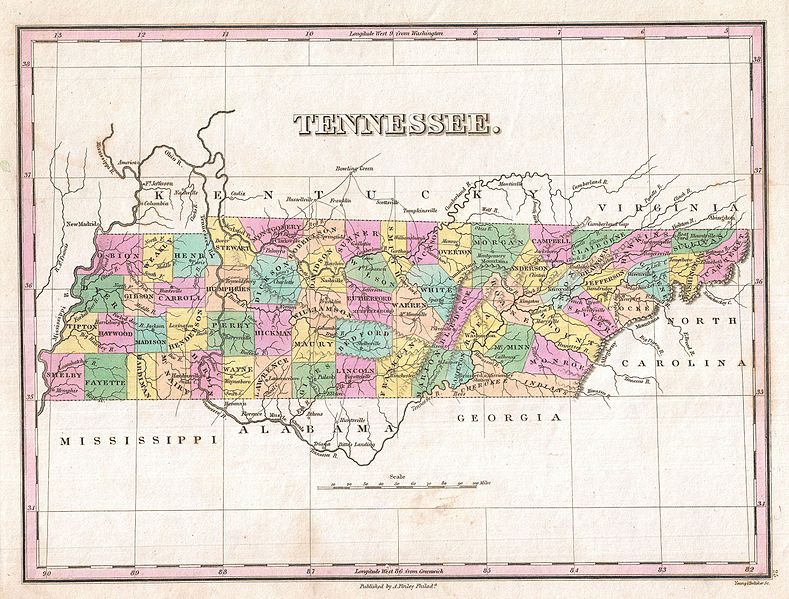
I come from a very large family which none of us knew much about until recently.  Mother and Daddy both were born and raised in a small farming community in Montgomery County, Tennessee. Daddy was a Jones, Mother was a Bowers.  My cousins on the Jones side liked to joke that it was a wonder we weren’t all idiots, since there were Joneses and Bowerses on both sides of our family trees.   My parents went through the Great Depression, and told me that sometimes they had nothing but biscuits and sawmill gravy to eat.  Neither graduated from high school.

Mostly my relatives were tenant farmers or blue-collar workers.  No one had gone to college before my generation.  To me it was a point of pride that we had apparently been in Montgomery County forever without making much of a mark on it.  We didn’t have any
glorious Civil War history to recount and apparently were too poor to own slaves.

I thought of myself as an educated, liberal person over the years, having no heritage of slavery, lynching or Jim Crow atrocities to live down.  I also thought I came from a humble
background and, along with my sisters and brother, had managed to pull myself
up into the middle class.  Meanwhile, my cousins Bobby Bowers and Greg Jones had been digging into the genealogy of the Bowers family.  In December 2006 they  printed “The Descendants of Nathaniel Bowers, Rev., and Hannah Smith.”  My sister Sherrie sent me a copy, and I began picking my way through 12 generations of Bowerses.

Turns out my parents were distant enough as cousins to escape any incest jokes.  However, most of my other assumptions were not particularly true.  There had been  land, and perhaps education.  Nathaniel Bowers was a preacher and was born in Connecticut (date unknown).  His wife was born in 1683.  His grandson James fought in the Revolutionary War (with the rank of Capt.) and received a pension, moving to  Montgomery County from New Jersey around 1820.  James owned 400 acres of land—a war land grant?

During the Civil War, Corporal John Claiborne Bowers was sent home with malaria the
day before the surrender of Fort Donelson to the Union army, so he avoided
going to prison camp with the rest of the Confederate soldiers.  Yet he had been there, so he may have fought.  Family lore said he was paid to fight by a more affluent neighbor, which was common at the time. His widow received a Confederate Army pension.

The genealogy book noted births, deaths, pensions, deeds, census data, and even a
newspaper account of an apparent multiple murder including the husband of one
of the Bowerses in 1878.  The question of slave ownership was never raised.  Nothing
explained how the land had gone away.

I emailed Cousin Bobby about it, and he said he didn’t look into slave ownership.  But what he did find out changed my view of our family history forever. Education, property, Revolutionary and Civil War veterans—not what I thought I knew.  And still a lot of
buried history.
There Is No Frigate Like a Book

Do you remember when you first learned to read?  I don’t remember the date, but I do remember the sensation.

I was five years old, not yet in school.  My parents and my sisters had read to me for years, and I loved books already.  But I loved most sitting in Daddy’s lap while he read the “funny pages” to me every Sunday.  At some point the words in the comic strips suddenly made sense to me before he read them out loud.  It was like something clicked in my brain, and there was no going back.

It was like waking up in Wonderland!  I read books, newspapers, cereal boxes, signs, anything with print on it.  Mother and my sister Sherrie taught me to write, which opened up another world of pleasure.  I fell into a world of words, and I’ve never left it since.

How powerful it is to read other people’s stories, thoughts, and feelings–and to express your own!  To voyage to worlds you will never see, or that only exist in someone’s imagination!  I love movies, photography, theater, and even online games sometimes (I’m struggling not to become an Angry Birds addict).  But I rejoice in the magic of words.  Emily Dickinson put it best:

There is no frigate like a book
To take us lands away,
Nor any coursers like a page
Of prancing poetry.
This traverse may the poorest take
Without oppress of toll;
How frugal is the chariot
That bears a human soul!

High School Daze

In high school I thought life was happening somewhere else, not in the rural backwater where I lived.  A lot of it happened on TV; I saw it every night.  I spent those years getting ready to be somewhere else.  And then I was afraid to go.

The black high school and the country high school were closed down, and we were all
bused into the white town high school for our sophomore year. I rode the bus for an hour and a half each way, every day.  There were 3000 students in the school.  One day there were rumors of a race riot.  I think two kids had a shoving match in the hallway.   One of my best friends was black.  The other black kids hated her; she was very smart and very sarcastic.  She designed her own clothes and was the first person I ever saw wear clogs or knickers. Years later she got into the New England Conservatory by threatening them with a lawsuit.

I wrote poems and stories.  I read Jane Austen’s novels for  the first time.  I read a lot of Reader’s Digest Condensed Books and wondered what the missing parts were like.  I thought Anne Morrow Lindbergh was a sap.

I named my black cat  “Firecat” after the Cat Stevens album.  My mother changed his
name to Tom.  She said I couldn’t name him something she was embarrassed to yell out the back door.

We lived across the state line from Ft. Campbell, Kentucky.  Helicopters were always flying over our farm. My senior year was the last year of the draft lottery.  I got a POW bracelet two months before the cease-fire.  But my officer  was MIA in Laos, and he never came back.

When our new high school opened I only had to ride the bus for 45 minutes each way. Our school colors were green and gold, green from the country high school and gold from the black high school that had closed.  Our mascot was the Viking, so of course “Valhalla” was our song.  Our school was 60% white and 40% black.  We had black cheerleaders, band members and football players, even student council members.  We thought we were cool and only rednecks were racists.  A few years later drugs destroyed the school.    They
put a chain link fence with a guard post around the school.  Every week German shepherds sniffed through the lockers.

I had braces and bad skin for most of my high school career.  Then my senior year things started to change, but it was too late to become popular.

A lot of other things happened that merit more discussion, like my dad’s heart attack, and how Latin changed my life (really, it did).  More on those later.  But my high school days ended at last with graduation.

I was the valedictorian of my class.  The title of my graduation address was, “The Meaning of Life.”  I think it had something to do with service to others, which seems unlikely for me to have made up

Before my brother's wedding, 2 years after graduation

.  Four of my classmates got married on graduation day.   Then there was just a long, dull summer to get through, and my new life could begin.

More Than Flags and Fireworks

Photo by Josh Wickerham
The little town where I live has a Memorial Day parade every year at 9 o’clock in the morning.  When I first moved here, I would roll out of bed, get dressed and walk up the street to watch.  It was a very small parade, with just a few aging veterans riding in convertibles and almost no one marching.  And the crowd watching was thin, not enough to line the sidewalks.  In the last few years the parades have included marching Girl Scouts and Boy Scouts, so at least the parents help bolster the crowd.

For most of us Memorial Day weekend has become the beginning of the summer season.  Any links to World War II or more recent wars seem increasingly tenuous, or degenerate into flag-waving and pompous speeches.

So today I’d like to shift the emphasis back to people–people who gave their lives in military service, primarily, since this is Memorial Day.  But also people who served in wars and came home safely or forever marked by their experience, people who served when there wasn’t a war, people who stayed behind and worked and worried, people who spoke up when they thought something was wrong.  People who mattered then, and matter now.

And I’m making a shout-out to veterans in my family.  One of my brothers-in-law served in the Navy during the Korean war.  Another was a career Army officer and did two tours of Vietnam.  My brother was in the Air Force during the Vietnam era and did not see combat.  They came home safely, and I am glad. There are many things on which we don’t agree, but we agree that we love our country and we love our family.  Happy Memorial Day.

Remembering Uncle Floyd

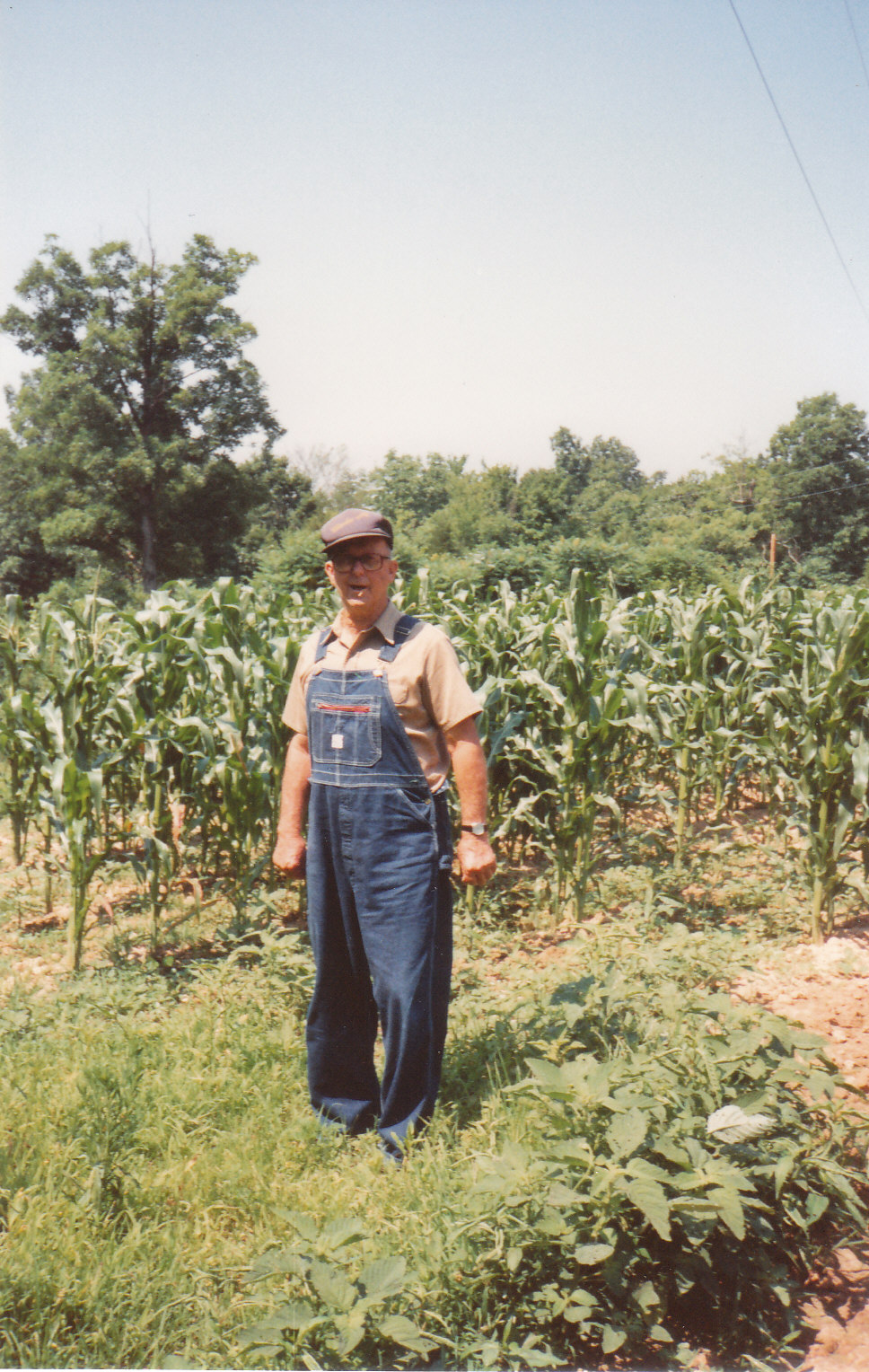
Recently I found this photo of my uncle Floyd, standing in front of his cornfield.  It must be 30 years old, at least.  Uncle Floyd married my mother’s sister Mattie Lou.  This
field was beside their house, a dogtrot cabin with a porch, white siding and a tin roof,  where they lived with Uncle Floyd’s mother, Miss Blanche, until she died at nearly 100 years old.

Uncle Floyd was not a believer in modern ways, especially if they cost money.  When my parents built their house on our farm in the ‘60s, they had a well dug, and we had indoor
plumbing and a washer and dryer.  Uncle Floyd and Aunt Lou had a cistern with a hand pump, a wringer washer and an outhouse.  I remember staying overnight with them and trying my best not to make a bathroom run.  In the summer wasps loved the outhouse, and
spiders lived there until the cold killed them in the winter.

When “city water” came in, Uncle Floyd planned to have the pipe run to the backyard pump, not into the house.  My father’s youngest brother Preston, who was running the pipe from the water main, refused to do it unless he could put it in the house.  So finally Aunt Lou had running water, and they installed a bathroom.  At the time it seemed insane to me to live that way, but now I realize Uncle Floyd probably had never had indoor plumbing, and he thought it was a luxury.

Many nights I sat in the porch swing with Miss Blanche while Uncle Floyd told us stories about his days working on a barge on the Cumberland River, or about the boys he and Daddy grew up with.  They all had nicknames like Goat or Beetle (after Beetle Bailey, for a guy who had joined the Army).   One story ended, “I knocked that dead cat out from under the house with a rake.  It was dead and smellin’.  And that thing sat up and looked at me!”

Uncle Floyd liked to call me “Knothead,” for reasons which weren’t clear to me, but his affection was plain.  When someone dropped a shaggy puppy at their house, he brought him to me, saying he knew I needed a dog.  Mother was not pleased, but I named the dog
Dusty and loved him through junior high and high school, until he died.  Uncle Floyd always saved some pork tenderloin from their hog killing and froze it for me so I could have the best part of the hog when I came home from college, and brought me their smoked sausage at Christmas.  He never said, “I love you,” but he did say, “I sure do miss you, girl.”

Apocalypse, Not Right Now

When it was 6:01 p.m. EDT I called my sister Glenda to make sure the rapture hadn’t happened.  I figured if any one of my family or friends would be taken, it would be her.  She was still there, and I alerted her to the fact that the Preakness would be run some 15 minutes earlier than she thought, so she and her husband could watch.  None of us had any money in the race.

I think I’m what one of my college professors called a “Zen Christian.”  I was brought up a Southern Baptist, and we spent a lot of time studying Revelations.  I remember one Sunday school teacher positing that the Mark of the Beast might be our Social Security Numbers, or a credit card, or some other sort of government I.D. But the verse that always stuck with me was the one that Zonker quoted yesterday in Doonesbury:  http://www.doonesbury.com/strip/archive/2011/05/20

Doonesbury

And today, as Zonker quotes, it is apparent that the Lord cometh as a thief in the night.

Doonesbury

But I am sad and sorry for the folks who quit their jobs and sat on a mountaintop, so to speak, waiting for the end.  I was reminded of those pathetic creatures of Heaven’s Gate, and so many others over the millennia who have waited for justice, retribution and destruction.

I think the most helpful things Jesus ever said were, “Love thy neighbor as thyself,” and, I forget the exact verse, but the gist was, live today and take care of those in need.  Let the future take care of itself.  Peace out, and love to all my family, friends and those in need of love.  Amen.

Blackberries, Cobbler, and Ticks

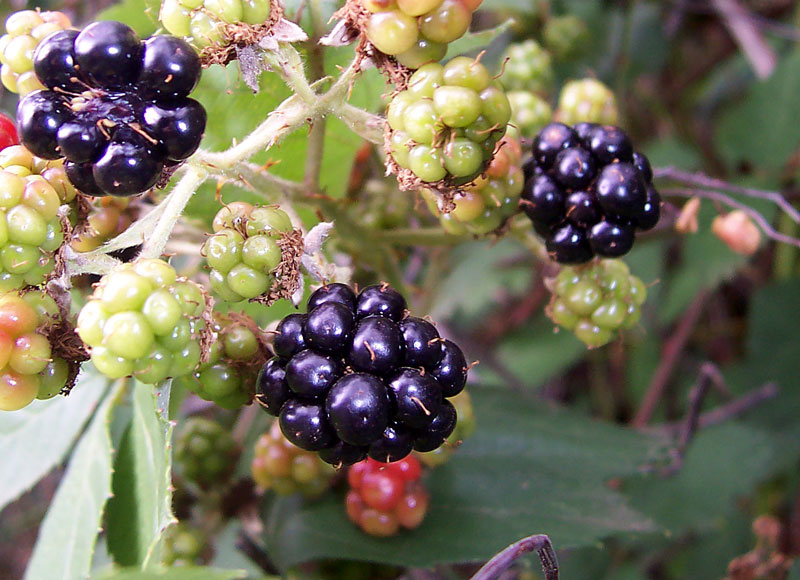
The best blackberries are wild ones, picked in the heat of summer from brambles in a fence row or along the side of an old dirt road.  The wild ones just have more flavor than domesticated ones.  That squirt of purple juice is richer and sweeter than any strawberry.

Photo by Fir 0002
When we lived on the farm Mother and I picked quarts of them every summer.  This was an ordeal.  Mother always carried a stick in case there were snakes, but the real enemies were chiggers and ticks.  We would dress in long sleeves and long pants, socks and shoes, sweating in the heat, in an effort to foil them.  The blackberry bushes were full of thorns and stickers to tear at your hands.  I always emerged with scars.

After filling up as many plastic buckets as we could carry (if the bushes were full), Mother and I trudged back up the hill to the house.  Then the real work began–hunting for the tiny, biting vampires before they got a chance to attach and suck your blood.  The ticks were smaller than deer ticks; I could only see them if they were in motion.  If I missed one, Mother would light a match, blow it out, and touch it to the tick to make it let go.  We checked each other to make sure none got away.  That’s the action referred to in Brad Paisley’s immortal song, “Ticks.”

But the end result of all the blood and labor was blackberry cobbler.  Here is my mother’s easy cobbler recipe.  You can use any fresh or frozen berries, except I don’t recommend strawberries.

Easy Cobbler

Spray bottom of a 9″ x 12″ baking dish (like Pyrex) with Pam or other oil spray.

1 cup flour

1 cup sugar

1/4 tsp. salt

2 tsp. baking powder

3/4 cup milk

1 stick butter or margarine, melted

2 1/2 cups berries, sweetened with 1/2 cup sugar

Mix all dry ingredients in baking dish.  Add milk, stir well.  Pour melted butter over dough.  Place sweetened berries on top.  Bake at 350 degrees until top is brown, 45 minutes to 1 hour.

Halcyon Days

Halcyon days are a time of peace and calmness, when the sky is blue, the ocean is calm, and one feels safe and loved.  The expression comes from a story in the Metamorphoses of Ovid, a Greek classic whose theme is transformation.

From mendocino.edu
Ceyx was the king of Trachis.  He and his wife Alcyone, the daughter of Aeolus, god of the winds, were happy together and devoted to each other.  But Ceyx became possessed with the desire to visit a distant oracle and get a prediction of the future.  Alcyone pleaded with him to stay, but he boarded a ship and set sail.  When he was far from home Poseidon called up a mighty storm.  Everyone on board drowned, including Ceyx.

Alcyone went to the shore every day to look for his ship returning.  Day after day she stood on the beach, filled with terrible forebodings.  Finally Aphrodite, goddess of love, sent Ceyx’s ghost to her in a dream and told her to go to the shore.  As Alcyone ran into the water toward her husband’s body, Aphrodite transformed them both into sea birds, bringing Ceyx back to life.  When the halcyon birds build their nest on the sea, Aeolus calms the winds, and the skies are clear.

I saw Mary Zimmerman’s production of the Metamorphoses on Broadway in 2002.  The actors seemed to turn into birds before my eyes.  I’ve never seen a production that moved me more.

I think we all wish for everlasting love, and we all know, even if we find it, we will lose it—to time, illness, death or depravity.  The object of even the strongest love will end.  But if we are lucky, or the gods intervene, the love itself goes on.  And
perhaps there will be halcyon days.

Cowboys in Tuscany

Casa al MonteFriends at the Villa 2001

During the summer of 2001, eight of us friends rented a villa outside Panzano, Italy on a working farm.  The owners lived in the other wing of the house and grew grapes and olives.  They also kept a couple of  horses, Oskar and Luna, for riding. Our group enjoyed looking at the rolling hills,  watching the horses graze while we sat on the flagstone terrace as the sun set,  and talking until late at night under the stars.  The villa was our home base for a week while we explored Siena, Florence (Firenze), Montalcino, Montepulciano, and Panzano itself, which had charming restaurants and a renowned shoe-maker.  We also cooked a lot of our meals and went through a ridiculous amount of the local wine.

One day half the group went to San Gimignano to see the sights.  The rest of us decided to have a lazy day at the villa’s pool.  Sally had broken a bone in her foot six weeks before we left for Italy.  She had touristed through Rome, Florence and Siena in an orthotic boot, so she thought a day at the pool would be a nice break.

Friends at the Villa, 2001

Sally, Scott, Nancy and I were sitting on the terrace reading and relaxing when  we heard a clopping sound.  Oskar and Luna were standing in the yard looking at us, and the fence was down.  Sally jumped up and caught both horses by their halters, while I tried
to find some rope so we could tie them to a tree or something.  There was no rope in any of the outbuildings, so Scott closed the farm’s electric gate to keep them from straying onto the road.  The owners were away in Florence for the day.  Nancy called them on  their mobile phone and reported the problem.

Oskar and  Luna were patient with us, but they didn’t stand still, and they had big, heavy
hooves.  One of them shifted his weight  and stepped on Sally’s broken foot!  She
yelled and let him go.  The horses  drifted to the front yard, and Sally put an ice pack on her foot.

Then a real  Italian cowboy arrived, on a motorbike.  The owners had called him to come fix the fence and get the horses  in.  He wasn’t much like John Wayne.  He was small and handsome, with a ponytail and a tan, and  wore shorts, stylish sunglasses, and hiking boots.   He said something like, “Los cavallos escapa,” and we said, “Si, si.”

Turns out the horses  had broken their water pipe and were thirsty, so that was why they broke down the fence.  Our cowboy fixed the pipe, repaired the fence, put the horses back in  their field, and took off on his motorbike, smiling and waving.

I plan to write more about this trip.  It was an amazing time, overshadowed by illness in my family at home, but still a fun, peaceful interlude.  Then later that year came 9/11, and the world changed.