Best Year So Far

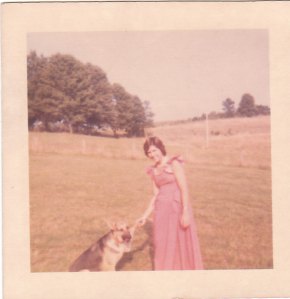
That's the dress!This may sound strange, but I think the best year of my life so far was when I was five years old.  I was the youngest in the family and everybody’s little princess.

My sister Juanita spoiled me terribly.  Her senior year in college, when I was five, she got a small, white, rather ancient Austin Healey convertible.  She liked to dress me up and drive around campus with me riding shotgun.  Her friends and boyfriends always clustered around the little car whenever we stopped.

Juanita got me a library card when I was five.  I had already learned to read, so this accelerated my love of books.  When she graduated and got a job as a secretary and bookkeeper, she bought dresses for me.  I remember a green one with white puffed sleeves and white embroidery, vaguely like a German peasant dress.  She took me to her hairdresser for my pixie cut.

Juanita even wrote to Miss Norma who was on the Romper Room children’s TV show in Nashville, so Miss Norma would see me through her Magic Mirror and call my name.  I thought Juanita was beautiful, with her tiny waist, short dark hair and blue eyes, and her party dresses, frothy with crinolines.

My sister Sherrie, who is 9 years older than me, played school with me, so besides knowing how to read I had basic math down as well.  She was patient with me most of the time, which was especially meaningful since we shared a bedroom and she was a teenager.  She moaned when I woke her up at 3 a.m. on Christmas Day, but she got up with me to see if Santa Claus had come.

My brother Gil was more problematic.  He got me to quit sucking my thumb by convincing me it would turn purple and fall off if I didn’t stop.  He also liked to use me as a human shield when he and Sherrie were fighting.  But how annoying is a five-year-old to a 12-year-old boy?

The fun was over in late August of that year, when school started.  I went into first grade as a five-year-old turning six in October, among the youngest, smallest and most scared in my class.  And I stuck out like a sore thumb because I’d already done all the first grade work.  My teacher gave me second grade work to do, by myself, and I joined the class for arts and crafts and recess.  No wonder I cried to stay at home!

Eventually (in second grade) I got over the strain of being alone and different in school.  Mother bribed with a Madame Alexander doll to go to school and stay there.  So life went on.  And I grew to love school, do well, and fit in.  But I still remember playing school with Sherrie and riding around in that Austin Healey.  At least I got to be a princess for a year!
 

Time, Time, Time, or the Alarm Clock

Photo by Alan Cleaver
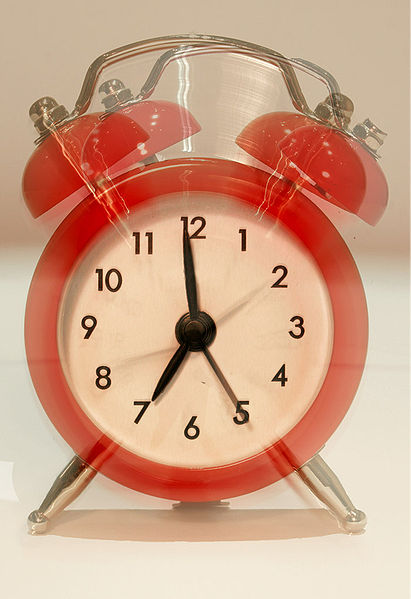
I have an emerging alarm clock crisis.  This is not an issue, I find, that most people deal with these days.  Kids use their mobile phones as alarm clocks, as well as wristwatches, and have just about made those timepieces obsolete.  Watches only survive as fashion items and status symbols among the young crowd.  The bedside clock has become a charging stand for your iPhone or iPod.

However, some of us still like to have an alarm clock on the nightstand.  My problem is that I want an analog, silent, not-illuminated alarm clock with hands that glow faintly in the dark–in short, I still want the G.E. electric alarm clock I have had since I was in high school decades ago.

My parents gave me that clock so I could be responsible for getting myself up and on the school bus at the crack of dawn.  They were up, too, but the idea was that I needed to learn to do it myself, because they would not be there to get me up when I went away to college.  I was never a heavy sleeper, so one buzzing alarm was enough.  I carried the clock with me to college and after, and never saw the need to replace it.  Clock radios?  I didn’t want to hear music at that hour, much less talk.  Battery operated?  Only if I had to travel.  I never thought about the little clock at all.  I realized this is the last remaining appliance my parents gave me.  Pretty amazing when you think about it.

I love this clock and it has served me well, but the alarm seems to be wearing out.  It just hums now instead of giving a full-out buzz.  Frankly, at its age, I can understand, and most days a hum is enough.  But what if I really need it to wake me?  So I started on a search for another clock this weekend.

I know you’re thinking, why not just get a digital clock and shut up about it?  The answer, my friends, is the amount of light those blasted LEDs put out.  When I sleep in a hotel room, I cover the standard bedside LED clock-radio with pillows to block the light.  I need it dark to sleep!  Okay, so why not get a clock that you have to push a button to illuminate?  Well, unfortunately, I wake up a lot in the night, and I think that Indiglo is disruptive.  And I’d have to reach over the cat to hit it, most of the time, which would certainly wake me up all the way.  How much simpler it was when I slept like a log through almost anything!

I bought two different clocks this weekend and returned them both.  One had all the attributes I wanted, except it was battery-operated and ticked so loudly it could wake the dead.  The other was silent, but had a light-sensitive face that immediately illuminated in the dark and couldn’t be turned off.  So I searched Amazon and finally googled every attribute I wanted.  The Seiko is in the mail, and we’ll see if it performs.  If not, I may have to enter the age of iPod/iPhone as alarm clock, but I will be unhappy!

Recipe: Corn Pudding, from Mother’s Sunday School Class

Mother
I was feeling a bit down today, and decided to cook a bit in an attempt to cheer myself up.  Not too much, mind you–cooking, I mean!  So right now I have yellow squash and onions simmering in a pot, “cooking down” with a little water, salt, pepper and a bit of butter.  I’ll let it cook until it’s pretty limp or I’m ready for dinner, whichever comes first.

The smell of squash and onions cooking always reminds me of my mother and summertime on the farm.  By this time of year we were inundated with squash and tomatoes, but there was never too much corn.  I dug out Mother’s Sunday school class cookbook, looking for recipe inspiration.   The cookbook was a fundraiser for the class; there are companies that still produce these today.  Mother wrote inside the front cover, “For Connie, 1990.”

The recipes are not “authentic southern cooking” at all.  These ladies were in their 60s and 70s then, and to them, fried chicken and homegrown vegetables were not “company” dishes.  So many of the recipes call for Campbell’s soup, Jello, cream cheese, cake mix, and other convenience foods.  I understand their point of view–when you were cooking three meals a day, every day, convenience was a wonderful thing!  And you know what?  It still is.

However, I was relieved to see that Mother’s contribution did not involve any of those, or even “oleo” as some of the recipes called it.  Here is her corn pudding recipe, which I suspect she got from my sister Glenda.  I don’t remember having this as a child, but it does sound good!

Corn Pudding

2 cups fresh corn, cut from the cob

1/4 cup all-purpose flour

2 to 3 tbsp. sugar

1 tsp. salt

2 cups milk

2 eggs, beaten

2 tbsp. butter or margarine

Combine corn, flour, sugar and salt.  Stir well.  Combine remaining ingredients in another bowl, mixing well.  Stir into corn mixture.  Pour into lightly greased 1 1/2 quart casserole.  Bake at 350 degrees for one hour, stiring twice during first 30 minutes.  Yields 6 to 8 servings.

Fronie Jones

Sweet Tea

There was always a half-gallon glass jug of sweetened iced tea in our refrigerator, all year long, when I was growing up.  Daddy drank a huge glass every day at lunch and every night at dinner.  In the heat of summer he drank more than one.  I still have that old glass–it is a big amber-colored glass from some gas-station giveaway.

Mother made the tea fresh every day.  It was strong and sweet.  She put in two scoops of sugar with a red plastic scoop from the copper-colored sugar cannister on the kitchen counter.  Sometimes we had lemon wedges to squeeze in your glass, which was my favorite way to drink it (still is.)  Nothing was more refreshing on a hot, humid day.  Sitting at the dining table, air conditioner humming, with fried chicken, hot biscuits, creamed corn cooked in an iron skillet with bacon grease until it stuck, homegrown tomatoes, and iced tea–heaven!

Here is Mother’s methodology, which made sweet tea strong enough to stand up to ice cubes but never bitter.

Sweet Tea

Take 2 large or 4 regular tea bags (Lipton’s preferred.)  Put in a teapot.  Fill the pot with boiling water and let steep 10 minutes.  In a half-gallon glass jug or other non-reactive pitcher, put 1/2 to 1 cup sugar.  Pour in the hot tea when it finishes steeping, and stir to dissolve the sugar.  Then add tap water to fill the jug, stirring.

Ready to pour over ice or cool in the fridge.  Makes a half-gallon (2 quarts.)  You can serve with lemon wedges or fresh mint if you have it.  It should be a deep ruby color, even when poured over ice, and never bitter!

Good Friends Are Hard to Find

Best friend in college! Ok, Sallie was too.
This article in the New York Times style section today made me stop and think about the nature of my friendships and how they are changing.  http://www.nytimes.com/2012/07/15/fashion/the-challenge-of-making-friends-as-an-adult.html?ref=style

I thought it was wrong about some things, however.  Are your best friends throughout life the ones you make in high school and college?  I think that’s unlikely, unless you all stay in the same area, have the same educational and financial circumstances, and see each other often.  Like the article says, proximity and time to build a friendship are essential.  If you move away, things change.   It’s easier to make close friendships when you are in high school and college, but that doesn’t mean they will stand the test of time.

All of us have work friends, neighbor friends, friends we share interests with, and for people with families, your kids’ friends and their families.  How does that progress to become the friend you call when your mother dies, or that you can ask to feed the cat, or the friend you can wake up at 2 a.m., or the one who will take you home from the hospital?

My closest friends now began as acquaintances, work friends, or people I met because we shared an interest.   It took years in most cases before they became intimate friends.  We helped each other out and learned we could count on each other.  We learned we had fun together but that our relationships didn’t have to be only fun and games.

And what do you do when those relationships begin to change?  Some people get busier.  Others, while still working, are no longer working full-time and are away for weeks at a time on vacation or travel.  Some get richer, some get poorer, some are unemployed.  It’s difficult when you’re no longer all at the same level and able to afford the same things.

All I know to do is to try to share new experiences with good friends as well as remembering the past, and to try to stay flexible as circumstances change–and try not to be hurt if close friends become a little more distant.   And I keep an eye out for potential new friends at “entry level.”  You never know if you’ll find another BFF.  And life is too lonely without people who are more than just casual friends.


Bad Perms and Good Times

Looking at old photos sometimes prompts a memory or gives a blog topic.  This one says, “What were we thinking?” on so many different levels.  My sister Sherrie came to visit me in New York a few times in the ’90s.  We went to Broadway shows, standing in line at the TKTS booth in the cold and snow.  And we had dinner at  inexpensive Italian or French bistros–I miss Quatorze to this day.

We walked and walked and walked.  Things were a little grittier then.  Times Square still had a rough edge, and the High Line was just some rusted railroad track in Chelsea.  We visited museums.  Sherrie was teaching high school biology, chemistry and physics, so we made a pilgrimage to the Museum of Natural History, where this was taken.

The main thing that strikes me is, we both had perms.  Back then, that was a good “working girl” alternative if you didn’t have time for hot rollers every morning.  But what a terrible look!  It wasn’t flattering for anyone.  If you don’t believe me, just look at Meg Ryan’s hair in “When Harry Met Sally.”  That movie still gives me the shivers over how many of those hairstyles I went through!  And look at the glasses.  I think I was in a contest with myself to see how ugly I could be!

I always had fun when Sherrie came to visit.  She wanted to get up early and see as much as she could.  “We can sleep when we’re dead,” she would say.  So off we would go.  Sherrie wasn’t snobbish or over-sophisticated or picky.  She just wanted to see it all.  She’s my favorite tourist.

Night Visitor

When I was a child, we had a small red brick house on a winding street in town lined with other nearly identical small red brick houses.  It only had two bedrooms, so my sister Sherrie and I shared a room, and my brother Gil slept in the attic.  It was built on a little hill, so the house had a walk-out basement garage, and a separate one-bedroom apartment next to the basement, which my parents rented out for a few years.

There were wooden stairs from the kitchen to the basement and garage.  Mother stored her canned vegetables and jams on shelves down there, while Daddy kept his tools and the lawnmower there.  This was where we went when a tornado warning went out and where Daddy considered building a bomb shelter during the Cuban missile crisis (but never did.)

Usually the garage door was kept shut unless Daddy was working on something in the back yard or the parking spaces–we had room enough for two or three cars to park.  Sometimes he worked on his old truck until dark in the summertime.  It always seemed to need something done to it to keep it running.

One summer night Mother and I were watching the black-and-white TV in the living room when something flew across the room and lodged itself in the drapes.  It was so fast  I almost felt it pass more than saw it.  Mother went to the door to the basement and found it cracked open.  “George!” she called.  “I think there’s a bat in the house!”

After a few minutes Daddy came up the stairs.  “That garage door must be open and it flew up here.  Do you want the broom?” Mother asked.  “Naw, I don’t need the broom,” he said.

He pulled on a pair of heavy leather work gloves and walked over to the drapes.  I could just see a small lump near the top of their folds.  In what seemed like one quick gesture, Daddy jerked the drapes back with one hand and grabbed the lump clinging to the inside with the other hand.

“You want to see, baby doll?” he said.  I looked in his gloved hand.  It was a bat.  He had picked off the drapes so quickly that its wings had not had a chance to unfold.  It was furry and grey, looking rather like a mouse.  I touched its warm stomach with a finger.  Then it opened it mouth and showed its tiny, needle-like teeth.

“Get that thing out of here, George,” Mother said.  “It could get loose and fly at our heads!”

Daddy chuckled.  “Don’t worry, old woman,” he said.  She opened the front door for him, and he turned the bat loose, flinging it up toward the sky.  It spread its leather wings instantly and disappeared into the night.

Mother made sure the garage door and the kitchen door were closed so we wouldn’t have any more visitors.   I was glad I got to see one up close.

Vegetable Gardens and Canning Green Beans (Recipe)

Photo by Mattysc@en.wikipedia
Several of my friends buy organic food, get locally-grown produce when possible or participate in farm shares.  Some grow their own tomatoes and herbs, but no one has enough space to have a vegetable garden.

I love fresh produce that hasn’t been shipped in from Mexico or Florida (or Chile, depending on the season), but I do enjoy having fruits and vegetables year-round, whether they are in season or not.  And I am glad I don’t have to grow my own food.

Anyone who has ever had a large vegetable garden knows it is hard work.  When I was growing up on the farm we had a garden with sweet corn, Kentucky Wonder beans, tomatoes (usually Big Boy), cucumbers, canteloupes, and yellow squash.

Daddy broke up the ground with the tractor then went through with the disc to break up the big chunks of dirt and marked out rows for us.  He put in a little fertilizer.  Then Mother and I planted everything, and it was our job to weed it and harvest what we grew.  One summer when Mother was sick Daddy and I planted the garden, and we screwed up–we put the cucumbers next to the canteloupes.  They cross-pollinated and did not bear anything.  Who knew?

Hoeing is a hateful job, especially in 90% humidity and early-morning temperatures above 80 degrees.  But it had to be done, because we did not have today’s genetically engineered crops which can be used with Roundup herbicide for no-till farming.  So we chopped out weeds as early in the morning as we could stand.  Our garden was not organic; we used a pesticide early on before the plants started bearing, or else there wouldn’t be a good crop due to the plants being eaten by insects.  Once the vegs started, the pesticide stopped, and the battle with the bugs began.

When the tomatoes came in I had many a stand-off with blister bugs when trying to pick ripe tomatoes.  Picking and shucking corn led to encounters with those big fat worms eating the end of the ears.  Some kind of wasp liked to hover around anything that flowered, like squash vines.

And the work didn’t end with picking.  Tomatoes were about the only thing that didn’t have to be prepared in some way, and Mother canned and froze dozens of quarts of beans, corn, squash and tomatoes each summer.  We also picked blackberries and froze them or made preserves and jam, picked pears from someone else’s farm and made pear preserves.  Mother even made pickles.  She had a recipe for lime pickles (made with lime–the mineral–instead of salt) which were delicious, crisp and a bit tart.  I was a largely unwilling assistant in all this.  I’ll never forget the summer we picked, broke up and canned 90 quarts of green beans.

Mother did not have a vegetable garden because it was healthy–she grew one to save money, to make sure we had good food for the winter (hence the canning and freezing) and because it was the way she was brought up.  I hated the work, but I did love the end product.

Here is a recipe of hers I just found for canning green beans.  This is a faster method than the usual cooking down to a mush for hours.  I have not tried this one!  You still have to put them in sterilized jars and make sure they seal.

Canned Green Beans

4 1/2 quarts green beans, broken

1/2 scant cup salt

1/2 cup sugar

1/2 cup vinegar

Put the salt, sugar and vinegar in a large pot with the beans, and bring to a rolling boil.  Cook about as long as you would fresh green beans you were going to eat right away.  Then put into sterilized jars and seal.

When ready to use, open a jar, pour off the liquid and season as you normally would fresh green beans.

Father’s Day: Daddy and the Whippoorwill

I get a bit sad as Father’s Day approaches every year, even though Daddy has been dead for more than 30 years now.  I still miss him.  A social worker I spoke to last week about a blog post I was writing for my job said it’s not unusual.  She said, “Feel your feelings, it’s all right to be sad.”  She also recommended doing something on Father’s Day to remember, whether it’s lighting a candle, writing a letter to your dad, or telling a story.

I remember so many things, but I decided this week to try to find a funny story.  I had dinner with some friends the other night, and we were talking about how certain kinds of birds have been singing at the top of their lungs at 3:30 or 4:00 in the morning for the last few weeks.  That reminded me of Daddy and the whippoorwill.

That was the summer our house on the farm was being built.  Daddy rented an old farmhouse from Mr. Johnny and Miss Ora, an ancient couple who lived further along the road from this house, so we moved to the country a few miles from the farm.  It was an old white clapboard house with a rickety porch.  The wood floors had cracks between the planks big enough to permit odd-looking insects to emerge on occasion.  I would not walk barefoot on those floors.

The house was not air-conditioned, of course, so we had to leave the windows open and use window fans or circulating floor fans to cool off as the summer got hotter.

The house was surrounded with old cedar trees.  There was a huge one in the back yard.  The trees made it shady most of the time, and they were a haven for birds.

If you’re not from the South you may not know whippoorwills.  They look a bit like meadowlarks, only they aren’t as pretty–no yellow throats on them.  What they are known for, and named after, is their call.  WHIP-poor-WILL, WHIP-poor-WILL, WHIP-poor-WILL, repeated over and over and over again.  Rumor had it that they sang faster when the weather was hotter, but no one has validated that claim so far as I know (unlike crickets, of which this is true.)  You hear them sometimes in a field during the day.  But during their courting season they like to get a jump on things by singing during the night.

One night long after we were all asleep a whippoorwill began singing from the clothesline on the back porch.  WHIP-poor-WILL, WHIP-poor-WILL, WHIP-poor-WILL!  Daddy ran out to the porch and shooed the bird away, then went back to bed.

He hardly got in bed before the bird started again, this time from the big cedar tree in the back yard.  WHIP-poor-WILL, WHIP-poor-WILL, WHIP-poor-WILL!  I could hear the murmur of Mother and Daddy’s voices.  Mother probably said something like, “Leave it alone, George, and it’ll quiet down.”  But the bird went on and on.  Daddy went out in the back yard in his boxer shorts and T-shirt and yelled at the bird.  It shut up the moment he came out.  But as soon as he was back in bed it started again.

That was it.  Daddy grabbed a shotgun and ran out to the cedar tree.  I got up and looked out to see what was going on, but it was pitch black.  I did hear Mother say, “George, put that gun down, you’ll just shoot yourself!”  The bird was dead silent.  Daddy waited a few minutes, then went back into the house.

Maybe the bird sensed real danger for it must have flown out of the tree.  I heard it calling again, but at a distance, out in tree-lined field in back of the yard.  So we all went back to sleep, to the hum of the fans, and no whippoorwill calls.

Flour Sack Dresses

Photo of feed sack dress from Va Voom Vintage
When Mother was a child on a small farm in Tennessee, one of five children, times were tough.  They grew most of their food, canning vegetables, preserving fruits, smoking hams and bacon.  Mother said there were days when supper was nothing but biscuits and sawmill gravy (made from leftover bacon grease, mainly.)  Cornbread and biscuits were the staples of existence.

When she told me that her mother made dresses for them out of flour sacks, I found this hard to picture or to believe.  I thought the fabric must have been rough, like a feed sack.  Recently I did a little research, and saw that the fabric was necessarily thick and tough, to protect the contents, which were basically flour or chicken feed.  But companies were marketers back then, too, so they began to use prints which looked more like something you’d want to wear, instead of advertising Martha White.

The only good part about it is that nearly everyone in their community was in the same state, so wearing a flour sack dress did not make you conspicuous.  The only halfway affluent person was the postman and his wife–and he also farmed and sold milk.  Mother was keenly aware that there were better dresses to be had, and that her family could not afford them.  And she loved her Papa so much, she would never have said anything to make him feel bad that he could not provide for more.

Nonetheless, she was thrilled when she got a new dress one fall that was actually storebought.  She set off for school with Elsie, her best friend (who married Daddy’s brother later when they were grown up. ) Elsie admired the dress, and asked Mother to switch with her.  So she did, and Elsie arrived at school in the new dress.  I can’t think why Mother did this, as badly as she wanted a new dress.  I guess she loved Aunt Elsie more.