Dressing: Smooth vs. Chunky

Major ingredient in dressing
Dressing, served with turkey or chicken, is an emotional subject in the South.  I have known people who wanted it to have the consistency of mush and won’t eat it if they can perceive the presence of celery or onions in the texture.

My family is a chunky dressing family.  I don’t have Mother’s recipe because she didn’t use one, but I do remember how she made the dressing for Thanksgiving dinner and how tasty it was.

Step one was to make a pan of cornbread, and step two to make a pan of biscuits.  She boiled a couple of eggs, chopped celery and onions, and crumbled the cornbread and biscuits together in a huge bowl.  Then she added the eggs, celery, and onions to the bread mixture, following with poultry seasoning, salt and pepper, and just enough broth to make it all stick together.  She tasted it to make sure the seasonings were at the right level.  Then she spread it in a large pan and baked it in the oven until it was warm through and browned.

While the dressing was browning Mother made giblet gravy.  She had boiled the turkey neck and giblets to make the base for the gravy.  Then she chopped the giblets, adding them back to the broth with what little meat came off the turkey neck.  The gravy also had chopped boiled eggs, poultry seasoning, salt and pepper, and sometimes a little flour to thicken it if I’m remembering right.

For me the turkey was definitely an afterthought.  At Thanksgiving dinner I’d fill my plate with dressing smothered in gravy, sweet potatoes with marshmallows, green bean casserole, fresh cranberry relish, and a small slice of turkey.  Yum!  It’s all about the sides.  The dressing was even more of a treat because Mother was convinced it would go bad quickly, so we only got to have leftovers of it the next day.

Occasionally Mother would make a smaller batch of dressing to go with a roasted chicken.  It was a lot of trouble because of the initial baking involved before construction of the dressing began, but it sure was good!

Holiday Prelude: Not Always Jolly

This time of year I miss my father even more than usual.  As we get closer to Christmas, I think of how it was always a difficult time for him.  He became very quiet and sad, depressed I guess we would say now.  His mother died in December, and he missed her as we got closer to Christmas.

I remember Mother saying to him, “You have to pick yourself up and do this for HER.  I won’t let you ruin HER Christmas.”  It took me a while to figure out that HER was me.

Daddy, to his credit, managed to pull himself together each year.  Mother and Daddy would argue about when to get the tree–he always wanted to wait until Christmas Eve, convinced it was a fire hazard, and Mother wanted it earlier so we could enjoy it.

I felt his cloud of depression beforehand, but we would go out into the fields and pick out a cedar tree to cut down for our Christmas tree.  Mother exhorted us to get one that didn’t have a fork in the top (a common flaw of cedar trees).  Daddy would cut it down, and we dragged it home, put it in a bucket of water in the garage or back yard, and let it soak up some water before taking it inside.

Nothing smells better than a fresh cut cedar tree.  the scent is sweeter and stronger than a pine tree.  And of course the trees we have now, cut in October in Michigan or Canada, coated in fireproofing spray and fake green, have no real smell to speak of.  A cedar tree smells like a wooden cedar chest, only green and alive.

Once we started decorating Daddy started to cheer up a bit.  I still have some of the strings of old lights we used, and the battered glass balls.  He did his Christmas shopping on Christmas Eve–old southern tradition, because you didn’t have the money to shop until then (unless you were doing layaway at Montgomery Wards).

These days I have a fake tree, since I’m usually away at my sister’s house for a few days, and I don’t like to leave a live one to get dry.  But I usually get a live green wreath or table arrangement.  I need that smell of fresh greens to make the holidays real.

High-Hat and Other Expressions

My family has been in Tennessee since shortly after the Revolutionary War, when one of the Bowers ancestors got a land grant.  That branch of the family came from England long before that.  Sometimes I have wondered if some of the characteristic expressions that Mother, Daddy and various of my aunts and uncles used go back that far.

Most of them were vivid, descriptive and not anything my friends from other places (like Pennsylvania, for example) had ever heard.  Mother used to complain that someone “high-hatted” her, which meant to act in a snobbish or condescending fashion, i.e., this person thought she was better than Mother.  There was no greater offense to Mother than to be looked down upon!  It looks like the term is derived from a “high hat” like a beaver or a topper which a snobbish person might wear.

Another one was to “be on your high horse.”  This means “to be disdainful or conceited,”  according to the American Heritage Dictionary.  Used in a sentence:  “Don’t you get on your high horse with me, young lady” (usually addressed to me).  This expression goes back to late Middle English, according to the online dictionary!  1375 – 1425, to be precise.  Who’d a thought?

My favorite, however, is “poor dog wouldn’t wag his own tail.”    This one is complicated.  It means, someone who is boastful or bragging, or it can mean someone who is too proud to speak of their own accomplishments.  The irony and understatement make me laugh.  When I looked it up, there’s another expression I had never heard:  “It’s a sorry dog that won’t wag his own tail.”  Apparently this one is from Georgia, and means self-promotion is ok.  The quote was from a judge in Atlanta.

Finally, the best one from Uncle Floyd, who was a font of old sayings:  “Drunker than Cootie’s goose.”  “Drunk” means dizzy or giddy in this old saying.  But who on earth was Cootie, and why did he have a goose?  This may be derived from “Drunker than Cooter Brown,” who apparently decided to stay drunk for the duration of the Civil War (not a bad strategy in my opinion). http://en.wikipedia.org/wiki/Cooter_Brown

Anybody else have a strange or funny saying from your family?

Faster Than Sound: The Concorde

Photo by Henry Salome
A few months ago I made a list of things I’ve done that I never thought I would do.  No, I haven’t robbed a bank or sailed solo around the world.  Some of them were things I never wanted to do, however, like choosing the flowers for my boyfriend’s coffin.  Others were adventures that never crossed my mind as a child in Tennessee, like going to Australia and New Zealand.  My dreams were pretty small, really.  One big adventure (among many) that I was pushed into by that same boyfriend was flying in a Concorde.

I had gotten sick when traveling in Guatemala and Jamaica on business, and was ill for several weeks after I got home.  Somehow this translated into panic and a fear of flying, which I’d never suffered from before.  Ron was panic-stricken at the thought that I didn’t want to travel.  Travel was life’s blood to him.  He was happiest when setting off to somewhere he hadn’t been before, preferably with a luxury hotel in an exotic setting at the other end, or at least Paris, his favorite city.  He often traveled without me on business, but was insistent that I come along as often as time permitted and I could afford it.

He had a trip coming up to France to visit a client and discovered that Air France was running a special:  buy a round trip business class ticket, and the New York-to-Paris leg was on the Concorde.  “You have to do this,” he said.  “We may never get this chance again.  And the client will pay!”  I was scared, but I agreed.

The plane was actually kind of claustrophobic.  It was narrow and the ceiling was low.  I took deep breaths and drank some wine.  Then the plane took off, and I felt–nothing.  You literally could not feel the acceleration.  After that, it was like being in a very luxurious subway car, only much smoother.  Then after a while I noticed the speed indicator; we were approaching Mach 2.  And I looked out the window.  I could see the curve of the Earth.  Wow!

I still felt a bit scared and shaky, but after that flight I didn’t panic again.  It really was magical.  The Concorde made absolutely no economic sense for the airlines, and I understand why the supersonic plane no longer flies.  But it’s a little bit of magic that’s gone from the world.

Recipe: Mother’s Cornbread

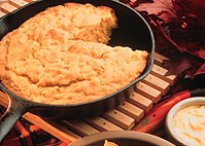
My  mother’s favorite cornbread recipe was not the traditional one she grew up with.  That one used only cornmeal, probably like a johnny cake, with bacon grease, salt and boiling water.  It was the cheapest type of food.  Mama, Mother’s mother, would make this kind of cornbread to feed the hounds when there weren’t enough table scraps.  When times were better the recipe incorporated an egg.  Here is a recipe for that type, credited to Alison Krauss, from the Martha White website: http://marthawhite.com/Recipes/Detail.aspx?recipeID=2564&mealtype=26

What follows is the recipe written in Mother’s handwriting, labeled “one I use.”  It’s my favorite too, if not for purists, or for us lazy slobs who use cornbread mix (Martha White might quarrel with me there).

Mother’s Cornbread

1 cup sifted flour

1 cup cornmeal (yellow preferred, but white is ok)

1 to 2 tablespoons sugar (your preference)

3 teaspoons baking powder

1 teaspoon salt

2 eggs well beaten

1 cup milk

1/4 cup corn oil (or canola would work)

Sift dry ingredients together.  Add egg, milk and corn oil.  Bake in an iron skillet in a 425 degree oven for about 30 minutes.

Tribulations of a Black Cat

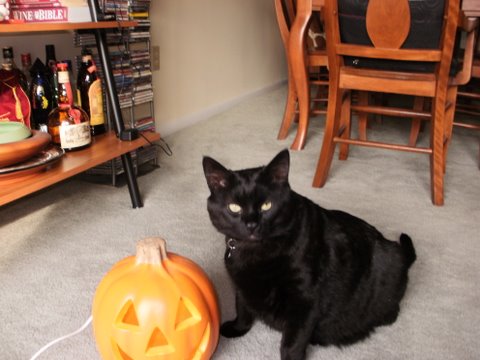
Nemo, last Halloween

My current cat, Nemo, is the second black tomcat I have had in my life.  He leads a fairly pampered existence and is unconscionably self-satisfied, as well as fat.  I fostered him for Forgotten Felines after he was abandoned in an apartment.  Needless to say I ended up keeping him (or he condescended to stay with me).  He’s lucky, because I have heard that black male cats are the last ones to be adopted from shelters.

He’s also luckier in many ways than the black tomcat I had on the farm as a teenager.  Someone had dropped him at the small grocery store and gas station miles from our house.  I had been sent to get some milk, and came home with the cat, much to Mother’s disapproval.  I named him Firecat, after the Cat Stevens album, but that lasted about two hours.  Mother said, “You can’t name him something I’m embarrassed to call out the back door,” and changed his name to Tom.

Tom, like most farm cats, got minimal care other than feeding and watering.  He lived outside summer and winter, spending cold nights in the barn.  I petted him, but he was not a cuddler.

Tom’s life was pretty good for a farm cat until I brought home another stray when I was in college, a tiny German shepherd mix puppy I named Chico.  Tom smacked the puppy with impunity and generally lorded over him.  But puppies grow, and before long Chico was even bigger than the average German shepherd.

Chico came up with a new game.  He closed his jaws around Tom’s head and carried him around the yard, the cat’s body hanging out of his mouth.  You could hear the cat’s muffled “meows.”  He never left a mark on Tom, but the poor cat must have been terrified.  I yelled at the dog until he dropped the cat, but I’m sure he did this a lot when I wasn’t there to intervene.  Tom started disappearing between mealtimes and staying well out of the dog’s reach.  Then he became very nervous–Mother thought he got hold of a mouse poisoned by strychnine, for he was high-strung and panicked at any sudden noise.

Tom finally moved to the woods and the barn, and would not come back even to eat.  I called him and called him.  At first he would answer me from the woods, but he wouldn’t come.  Then he didn’t answer.  He showed up at Aunt Lou’s house a few times, half a mile away.  Then he was gone for good.  He didn’t even come home to die, for Chico was still there.

You Can’t Go Home Again


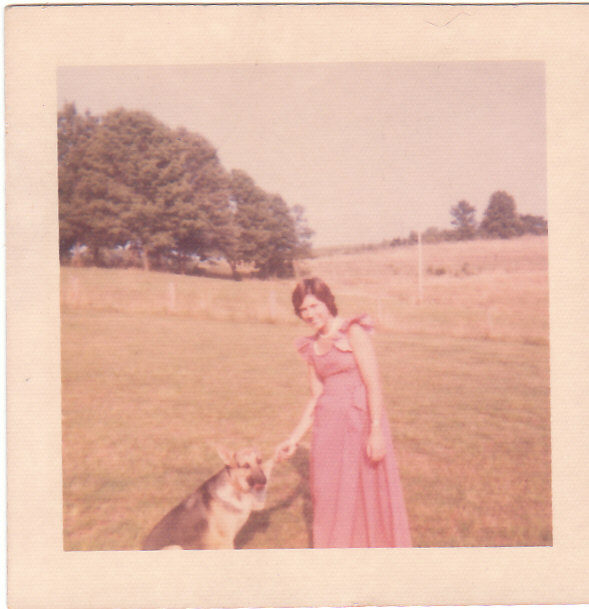
On the farm in better days, with Chico

“All things on earth point home in old October; sailors to sea, travelers to walls and fences, hunters to field and hollow and the long voice of the hounds, the lover to the love he has forsaken”–Thomas Wolfe

Some years ago I went back with my sister Sherrie to see our old farm.  I expected change.  Mother had sold the farm after Daddy died to her brother and his adopted son, then sold the house and acre-and-a-half yard around it to “a nice family”  when she felt she couldn’t keep it up any more.  Mother had moved to an apartment in town, then eventually to Ohio, where my sister Glenda took care of her until she died.

So I knew the place would be different.  I remembered rolling pastures, good for grazing cows but not for planting; wooded hills; a neat red brick farmhouse with a big oak tree in the front yard; a smokehouse and a shed in the back yard.  I also remembered the doghouse Daddy built for my dog Chico, painted white like the other outbuildings.

Sherrie drove us there in her pickup truck.  The long country road was lined with houses, some old ones, a lot of new ones.  There were very few farms left.  The old country store was still there at Stringtown, with new gas pumps.  As we got closer to our farm every house held memories of aunts and uncles now gone, cousins moved to town or other cities.

Sherrie pulled into the driveway to the farm.  “Look at that!” I said.  There was an elaborate sign that looked as if it were carved, saying something like “Full Gospel Holiness Church” and the name of the preacher.  “I heard he built a church in the yard,” Sherrie said.

The pasture in front of the house was grown up with brambles, weeds, and small trees.  The yard was cluttered with ragged bushes and children’s toys.  In the back yard, the smokehouse and shed were gone.  In their place was a tiny church with a minuscule steeple.  It had white vinyl siding and looked like it was built from a prefab kit.  The church couldn’t have held more than 10 people.

“Cousin Sandy says he got the call to preach and built this church,” Sherrie said.  “He gets his wife and a few other people on Sundays.”

You can’t go home again, as Thomas Wolfe wrote.  “Let’s go,” I said, and we drove away.

Recipe: Aunt Geneva’s Coconut Pie

Aunt Geneva was my mother’s youngest sister.  She was feisty and funny.  In her young days, she pushed the boundaries of behavior in their country community before World War II.  Aunt Geneva smoked, and drank when she got the chance.  She and their brother, Uncle Jesse (known as Fatty because he was so thin), played harmonica and guitar and sang at parties, which was expressly forbidden by their hard-core Baptist church.   Mother told me it was permissible to sing, but not to play instruments at a “play-party.”  They also were not allowed to play cards except for Rook and Old Maid.

Aunt Geneva was the only one of the sisters to learn to drive a car, work outside the home, and marry someone outside of the community.  She continued to work at a plant that manufactured shoe soles while raising two boys.  I was always happy when she came down to visit Aunt Lou because Uncle Fatty would come over with his guitar, and they would play and sing the old songs, as well as “Little Brown Jug,” “Froggy Went A-Courtin'” and “In the Pines.”

Here is the recipe for Aunt Geneva’s coconut pie.  It is not a coconut cream pie, but a dense, sweet, custard pie, and very easy to make.

Geneva’s Coconut Pie

1 cup sugar

1 cup milk

5 tablespoons flour

dash salt

2 or 3 eggs (2 large, or 3 smaller)

1 teaspoon vanilla

1 can coconut (or 1 cup flaked coconut)

1/2 stick butter

Mix all ingredients.  Bake in unbaked pie shell at 350 degrees about 45 minutes.

September 11: Remember to Love

On Friday I went to Trinity Church, on Broadway close to Wall Street, to hear a choral performance.  Trinity had choirs singing all day on September 9, either at Trinity Church or at St. Paul’s Chapel, which was a place of refuge and rest for first responders.  The church called the event “Remember to Love:  A Choral Blessing,” and invited choirs from Boston, Washington, DC and Pennsylvania to perform, as well as their own choirs and others from New York City.  http://www.trinitywallstreet.org/  (There are special services today, Sept. 11, as well).

The Copley Singers from Boston performed at 3 p.m.  The program included  Samuel Barber’s Agnus Dei, spirituals, and a part of Andrew Lloyd Webber’s Requiem, among other pieces.  Hearing their harmonies and the clarity of sound in the church filled with tourists, people who worked on Wall Street, and those who came just for the concert united us all in remembrance.

It ended with one I had never heard before, “Song of Athene,” by John Taverner.  I was moved by it.  I’m sharing the lyrics as they were printed in the program.  It sums up what I think we all hope for those who perished.

Song of Athene, by John Taverner

May flights of angels sing thee to thy rest.

Remember me, O Lord, when you come into your kingdom.

Give rest, O Lord, to your handmaid, who has fallen asleep.

The Choir of Saints have found the well-spring of life and door of Paradise.

Life:  A shadow and a dream.  Weeping at the grave creates the song:

Alleluia.  Come, enjoy rewards and crowns I have prepared for you.

Recessionista: Links and Recommendations

One of my dreams as a child was to be able to spend without worrying.  My parents grew up during the Great Depression, never went to college, and worked hard all their lives to support us kids and give us a better chance.  A big part of this was scrimping, saving and stretching as a way of life.  Another factor was debt, mortgaging the farm to pay for the current year’s crop.

I paid my own way through college and graduate school, and worked my way up to a comfortable life.  I’ve never been extravagant (although there are those who would argue with that statement), but I’ve enjoyed being able to eat out at will, buy what I wanted within reason, and pay off the bills every month.

Well, the Great Recession has put an end to all that.  I don’t mean to say this is as bad as Great Depression–there is no comparison.  But current days are a sad change from the good times we have all enjoyed in the past.  I have found a number of ways to keep some of the pleasures of affluence without spending much (or, in some cases, any) money.  Please share your recommendations!

  1. The public library.  My county has a wonderful library system, with books, DVDs, and music CDs, all for free.  My local library also has free lectures, musical performances of surprising quality, and other events.
  2. Through my library, access to Freegal, which lets you download music for free  http://www.freegalmusic.com/homes/aboutus  Your library pays for a certain amount of downloads up front for their cardholders, and they are available on a first-come-first-serve basis until the library quota is used up.
  3. www.paperbackswap.com This is a great way to get rid of books you don’t want any more and get books you do want to read.  All it costs you is the postage to send a book to the requestor.  Somehow I ended up with more books than I had originally (hmmm), but as a reading junkie, it helps feed my need.  And you can set up a wish list with automatic ordering!
  4. www.restaurant.com Eat. Drink. Save money (their tagline).  Users can buy coupons good for $25 or $50 at a subscribing restaurant for as little as $2.  Restrictions do apply.
  5. Tracking down free concerts and performances of other kinds through my local patch.com and organizations like the public library, Jazz Forum Arts (metro New York area), and the local newspapers.

I long to go back to my old, somewhat profligate ways.  Maybe that will happen soon.  But I intend to keep some of my newer, more frugal habits!