Visiting Aunt Lou and Uncle Floyd

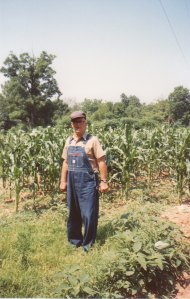
Uncle Floyd
What follows is an exercise I wrote for a class several years ago.  We were to remember a time and place that was lost to us, and write all we could remember.  So I did:

We drive up the blacktop road toward  sunset, my parents and I, the old Ford pickup laboring up the hill.  Turning into my uncle’s gravel driveway kicks up a small cloud of dust.  The truck wheezes to a halt, and the dust settles as we climb out and walk to the house.

Across the blacktop road from the house is a tree-lined field  with cattle grazing quietly in the dusk.  They are a motley bunch, a mix of  Herefords and Holstein crosses, too bony for good beef cattle, too stocky for good dairy cattle.  My aunt’s little Jersey is the only princess, with her fawn-colored coat, her delicate hooves, her big brown eyes.  Aunt Lou keeps the milk cow so she can churn her own butter; she thinks it’s better than store bought.

At the side of the yard is my aunt’s garden.  Honeysuckle spills over the woven wire fence, scenting the humid air.  The first two rows of the garden are flowers:  zinnias, marigolds, snapdragons, daisies.  The rest is food for the summer, and for preserving:  beans, corn, squash, tomatoes, cucumbers for pickles, canteloupes, watermelons.

In the shade of the back yard, past the chicken coop, is her mother-in-law’s wildflower garden.  Miss Blanche transplants sweet william, violets, and trillium from the woods, watering them faithfully. Their colors are paler and more delicate than the sunny flowers in the other garden.

Tall, old oak trees and maples shade the back yard and the front yard during the day.  Now that the sun is slouching down below the hill, birds rustle the branches as they settle in for the night.  They fuss and squabble in the trees.

The old clapboard house is painted white; the tin roof is shiny.  There’s a dogtrot hall running through the middle, with a couple of large rooms on either side and a kitchen in the back.  For many years there wasn’t a bathroom.

On a summer night the most important room is the front porch.  This is where we all sit and talk while night falls.   There is a porch swing, where I sit with Miss Blanche, and two wooden rocking chairs for the two men, tired from a long day in the fields.  My mother and Aunt Lou sit on metal chairs in the front yard, hoping for a breeze.

The women’s voices are low and even.  The men rumble in baritone, punctuated by my father’s laugh.  Miss Blanche and I are quiet as it grows dark, waiting for the tree frogs to begin their high piping.  Lightning bugs blink erratically  in the yard.  The humidity settles in the hollow like a ground fog.

“Look,” Miss Blanche says.  A deer broaches the mist in the hollow, sights us, and floats away into the dark.

Soon, the moon will rise above the hills.  It is time to go home.
You Can’t Go Home Again


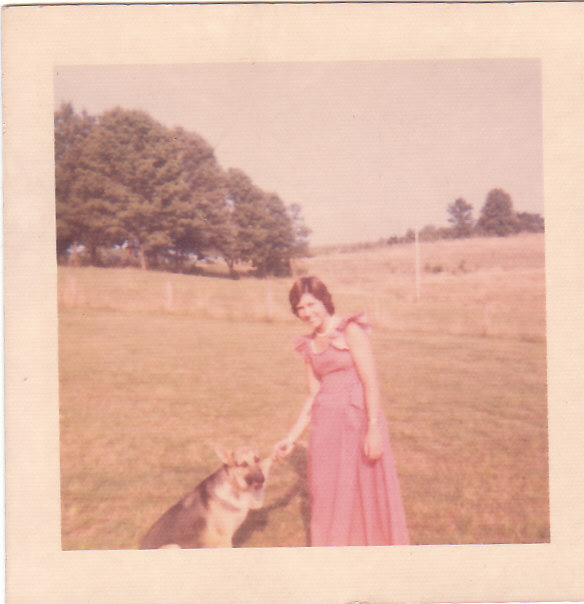
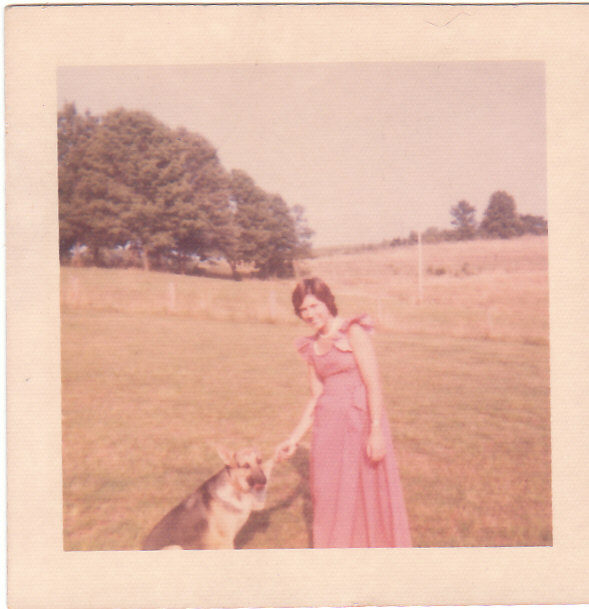
On the farm in better days, with Chico

“All things on earth point home in old October; sailors to sea, travelers to walls and fences, hunters to field and hollow and the long voice of the hounds, the lover to the love he has forsaken”–Thomas Wolfe

Some years ago I went back with my sister Sherrie to see our old farm.  I expected change.  Mother had sold the farm after Daddy died to her brother and his adopted son, then sold the house and acre-and-a-half yard around it to “a nice family”  when she felt she couldn’t keep it up any more.  Mother had moved to an apartment in town, then eventually to Ohio, where my sister Glenda took care of her until she died.

So I knew the place would be different.  I remembered rolling pastures, good for grazing cows but not for planting; wooded hills; a neat red brick farmhouse with a big oak tree in the front yard; a smokehouse and a shed in the back yard.  I also remembered the doghouse Daddy built for my dog Chico, painted white like the other outbuildings.

Sherrie drove us there in her pickup truck.  The long country road was lined with houses, some old ones, a lot of new ones.  There were very few farms left.  The old country store was still there at Stringtown, with new gas pumps.  As we got closer to our farm every house held memories of aunts and uncles now gone, cousins moved to town or other cities.

Sherrie pulled into the driveway to the farm.  “Look at that!” I said.  There was an elaborate sign that looked as if it were carved, saying something like “Full Gospel Holiness Church” and the name of the preacher.  “I heard he built a church in the yard,” Sherrie said.

The pasture in front of the house was grown up with brambles, weeds, and small trees.  The yard was cluttered with ragged bushes and children’s toys.  In the back yard, the smokehouse and shed were gone.  In their place was a tiny church with a minuscule steeple.  It had white vinyl siding and looked like it was built from a prefab kit.  The church couldn’t have held more than 10 people.

“Cousin Sandy says he got the call to preach and built this church,” Sherrie said.  “He gets his wife and a few other people on Sundays.”

You can’t go home again, as Thomas Wolfe wrote.  “Let’s go,” I said, and we drove away.

Emergency Dessert: Mother’s One Egg Cake

I don’t remember exactly when this photo of my parents was taken, sitting in the swing in the front yard of our house on the farm.  Daddy always wore khaki work clothes to his job at Fort Campbell and also to work around the farm.  Mother thought overalls were low-class, so he never wore them.

Daddy worked hard on the farm, and his job at Fort Campbell in his later years was demanding, too.  I can’t imagine a man in his 50’s unloading frozen sides of beef  and carrying them into the commissary meat locker, but that’s what he did.  Mother felt he needed meat and vegetables every night for dinner, and Daddy felt he needed a dessert as well.

Money was always tight, but we had our own beef and pork, generally one of the yearling calves and one pig that were slaughtered and frozen.  Mother canned and froze vegetables from our garden and apples and pears from various relatives’ trees, and made jams and jellies.  So we always ate well, thanks to her labor (and mine, an unwilling helper!).

The following recipe is the one egg cake she would make when she didn’t have a lot of eggs to spare and not a lot of time.  She generally served it with fruit or ice cream, or made a quick buttercream frosting.  I’ve used  it instead of shortcake with strawberries and whipped cream, or just dusted some powdered sugar on top and called it a day.  It makes a 8″ x 8″ or 9″ x 9″ one-layer cake, just right for four people.

One Egg Cake

2 cups flour

3 1/2 teaspoons baking powder

1/2 teaspoon salt

1 cup sugar

1 egg

1 cup milk

1 teaspoon vanilla flavoring

2-4 tablespoons shortening

Cream together shortening, sugar, egg, vanilla, and milk, then add dry ingredients and mix.  Bake in greased 8″ x 8″ or 9″ x 9″ pan in 350 degree oven (325 degrees if using glass baking dish) for 25 – 30 minutes.  It’s done when lightly browned and center bounces back if you touch it lightly.

Mama’s Tea Cakes

Blanche Ella Collier Bowers

I never knew my grandmother on my mother’s side; she died before I was born.  Mother’s stories about her made her sound like the taskmaster and moral guardian of the family, while Papa, Mother’s father, was fun-loving and mischievous.  Both Mama and Papa worked hard on their small farm all their lives, raising five children.  Mother used to say I had Mama’s hands, long-fingered and slim, while she had Papa’s bony, large-knuckled ones.

Mother learned to cook from Mama, as well as how to can and preserve vegetables and fruits, make jams and jellies, and generally make the most of what they were able to grow in their garden patch.  Most of the recipes were in her head, and Mother did not write them down.  When I was in high school I asked her for Mama’s tea cake recipe.  They are simple, thin cookies, that are in fact good with a cup of tea.  I struggled with these, because it helps to know how to handle biscuit dough without over-working it in order to make these cookies!

Mama’s Tea Cakes

2 1/4 cups sugar

about 2 cups flour

1 tsp. baking soda

pinch salt

2 eggs

2/3 cup buttermilk

1 tsp. vanilla

1 cup butter (or margarine, butter is better)

Preheat oven to 350 degrees.  Mix the dry ingredients and put them on the biscuit board or pastry sheet where you will roll out the cakes.  Make a well in the center of the dry ingredients, and pour the wet ingredients there.  Mix together until you have dough–don’t handle too much!  Roll out thin and cut into round cookies (biscuit cutter or a glass works fine).  Bake until lightly browned.

Optional:  Add lemon zest or orange zest.  Not authentic to the recipe or period, but a nice flavor.

Best Dog Ever

Chico and me on the farm

I grew up with dogs and cats, generally one dog at a time and, when we moved to the farm, multiple half-wild cats.  I loved them all, but Chico was the best dog.

I was in school at the University of Tennessee at Knoxville.  Walking down the Strip, a slightly seedy street lined with delis, head shops and bookstores, I saw a man standing on the corner with a box of tiny puppies.  “The mother’s a purebred German shepherd, but some mutt got to her, ” he said.  “If people don’t take the puppies I’m going to drown them.”

I was stricken.  I immediately hatched a desperate plan.  I took the only puppy who was marked black and tan like a German shepherd and took him back to my dorm room.  He lived in a box under my bed for a few days.  I named him Chico, because he was a little boy and because I liked the Marx Brothers.  I took him to the vet, who told me he was only 4 weeks old, and gave him vitamins.  Then I bummed a ride home for the weekend and took him to my parents’ farm.

Mother was not thrilled when I turned up with a puppy in a shoebox.  There was no question of him living in the house–pets were never allowed inside–and the weather was cold.  Daddy built a small doghouse from bits of wood and insulated it with styrofoam.  He put a light on an industrial extension cord, put the light in a coffee can, and wrapped it in a towel, so Chico had a space heater.  He even put an alarm clock in a towel so Chico wouldn’t cry.   Then he fenced a tiny yard with loose bricks so Chico couldn’t wander away. 

Chico never looked back.  He grew into a 110-pound German shepherd, always gentle, loving and patient with all the grandchildren.  He was devoted to my parents and never bit a soul.  Chico liked to take my wrist in his mouth, shake it, and let it go.  I thought nothing of it until I saw him crack a hambone in his jaws.  When I brought a boyfriend home he would walk between me and the guy.  He didn’t growl.  He didn’t need to.

After Daddy died suddenly Chico became Mother’s guard dog and protector.  He still roamed the farm and cadged food from the neighbors.  When he was 11 years old, feeble and shaky, he had to be put down.   I’ve never had a dog since then.  I’m pretty much a cat person now.  But I’m glad I brought that puppy home.

The Farm, 1974

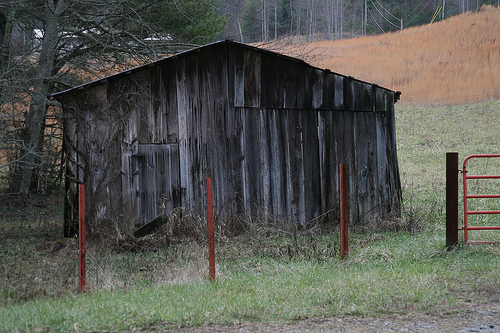
Shed on Tennessee Farm
Photo by Erons Pics

When I think of that time, it’s mainly the heat I remember, and the air so thick.  The woods  in back of the house were lush and green, but the pasture in front was beginning to turn brown from the August heat.  Even as the sun set over the ridge, smoldering red, it didn’t get much cooler.  The haze of heat dissolved from the fields, but the air was still with moisture and hard to breathe in.

Then it was dark, and it was darker than it has ever been again.  Dark as Egypt, my mother would say.  No street lights, no security light, the nearest house a half mile away across the fields and shrouded in trees.  Coming down the gravel driveway to the raw, red brick house and turning off the car lights, you saw streaks and spots that weren’t there, like the lights inside your eyelids.

Then you and the boy stumbled across the yard in the dark and sat in the swing under the big oak tree.  Slowly you could see again, first the dark bulk of the house, and then the stars.  There were more stars then, thick brushstrokes of them across the sky.  You could actually see the arm of the Milky Way, distant pinpoints in the dark.

A car would pass on the road, lonely and preoccupied.  There was the hum of the air conditioner in the window of the house, the high, monotonous peeping of tree frogs, the quiet whuffling of cows, settled down to sleep by the pasture fence.  A bird rustled in the tree above your head, shifting its perch. The swing creaked and its chains jingled when the boy suddenly stopped its motion.

Then the moon rose above the ridge, drowning the stars, silvering the ground fog smoking in the hollow.  You could almost count the craters on the moon, it was so bright and unnaturally big.  And you were not afraid of anything, not anything.

Suddenly the porch light flicked on and off.  The boy decided it was time to go.  So you went in the house, resentful, not knowing that nothing would ever be the same again.