Ice Storm

This winter has been very mild so far, except for a weird October snowstorm.  I’m not sure why I’ve been remembering the ice storms of my Tennesee childhood.  Maybe my sister Sherrie sparked the memories with her account of a storm a few weeks ago on their farm.

Snow was rare where I grew up, and always the occasion for celebration.  I got out my sled, and Daddy played with me as the runners sank into wet slush.  Ice storms were more common.  Rain would begin to freeze, then coat trees, roads and the ground with a glittering layer.  When the sun came out the next day, everything sparkled.  The reflected light was almost blinding.

Often the ice on the road would cause school to be cancelled, since the school buses couldn’t run safely on their long routes through the country.  There weren’t any snowplows or salt trucks, so we had to wait for the ice to melt before school could resume.

Sometimes the ice would be heavy enough that tree branches would break and fall on the power lines.  If the power was out in many places it could be days before it was restored.  The poor folks who went through this after the October snowstorm here know what that is like.  We had resources on the farm, however, that made a couple of days of ice storm aftermath seem like a holiday to me.

Daddy hooked up a generator to the freezer so our frozen food wouldn’t spoil.  We had a wood-burning stove in the garage, which never had a car in it, so the garage functioned as a den.  Mother cooked on top of the stove, which can’t have been fun for her, but I thought it was great.  She even allowed my dog to come into the garage, when normally he was banished to his doghouse.  Often my aunts and uncles on the main road would get their power back faster, so we were invited for lunches and dinners with them.  Afterwards they would all play Rook, the only card game they were allowed as young people and still their favorite, and laugh and talk.

Two days was about my limit, however.  After that I really wanted to be back in school with my friends since none of them lived nearby.  But a couple of days off with my aunts and uncles, and time to read all I wanted to, was a real treat.

Y’all Come Back, Now…

Mother and Daddy at home on the farm
I think I was in junior high or high school when Aunt Evelyn died.  She was an aunt by marriage to Uncle Fatty (Mother’s brother Jesse), and had been sickly for years.  Poor Aunt Evelyn was always having polyps taken out of her colon, in and out of the hospital at least once a year, and felt unable to cook, keep house, or do anything resembling work.  Mother disapproved of this mightily, and all the community paid lip service to feeling sorry for Evelyn while privately wondering if it was all imagined.  Then one of the polyps turned out to be colon cancer and she died.

Her body was taken to Nave Funeral Home, which had just opened.  Mother, Daddy and I drove into town for the viewing.  It was very strange going to Nave, because I had known it as something else–the Rudolph mansion on Madison Street, where my sister Juanita had rented an apartment with one of the Rudolph girls after she graduated from Austin Peay.

The Rudolph mansion was a square, three-story brick edifice with white trim, two or three porches, a porte-cochere, and numerous fireplaces, sitting in a spacious yard with old oak trees.  I remember that Juanita’s bedroom had a white-painted brick fireplace with a marble mantlepiece.  As a child I thought it the height of elegance (as I thought everything Juanita did or owned was).   The Rudolph family had lived there for many years, but I guess the upkeep got to be too much.  So for a while they rented it out as apartments.  Then they sold it to Mr. Nave, who made it into a funeral home.

The conversion was tastefully done.  The high ceilings and dark wood floors with carpet runners kept the feel of an expensive family home.  As we walked in a dark-suited usher greeted us, asked which viewing we were attending, and led us to the proper room.  Aunt Evelyn looked smaller and thinner than ever in her coffin, but the makeup added some color to her face, maybe more than she’d ever had in life.

Mother sat with the other women at a comfortable distance from the coffin, wearing her Sunday dress and talking in a low voice.  I sat with her, keeping my distance from the dead, and itching to leave.

Daddy stood by the coffin with a small group of his brothers, friends and cousins.  As always, he was pleased to be with them, and they all chatted.  Daddy even chuckled a bit at something one of them said, a kind of “heh-heh-heh” laugh.  “George!” Mother hissed in a shocked whisper.  “Now, old woman,” he said, and stayed with the group a while longer.

Finally Mother and Daddy were ready to go.  Instead of going out the front door, we went to the side entrance with the porte-cochere, since it was closer to the parking lot.  Another dark-suited attendant opened the door for us.  Mother thanked him.  Then the man smiled and said, “Y’all come back, now, hear?”

Daddy and I burst into helpless laughter.  We laughed all the way to our car as Mother tried to make us hush.

Girls and Horses

When I was a child, I wanted a pony or a horse so bad I could taste it.  I was obnoxious.  I read “The Black Stallion,” “Misty of Chincoteague,” and that dreadful sentimental tearjearker whose name I forget, about the carriage horse that gradually sank to pulling a coal cart (this was in England) and was rescued by an early member of the Humane Society.  Was that “Black Beauty”?

I collected glass figurines of horses and then some kind of high-class plastic ones which cost way too much money for what they were.  When I fractured a vertebra in my back (a story for another day) at 10 years old and was in the hospital for a week, my cousin Marvel baked a chocolate cake the day I came home, and topped it with a glass Palomino with a saddle and bridle.  That’s how far gone I was, and how public it was in my family.

What is it about girls and horses?  Putting aside the obvious sexual imagery (and please, I beg you to do that), I think it’s all about control of emotion and empathy for a larger, more dangerous other.  And it’s also that horses have big eyes, lots of emotion and not much in the brains department.  Kinda like men 🙂

I went to see “War Horse” last week.  It was both a beautiful, sweeping story of a boy and his horse, and a powerful antiwar message.  I highly recommend it.  You need to see this movie on a big screen–you cannot get the sweep and majesty of it on a DVD.

Why do horses move us so?  They have been noble creatures from their earliest days, painted in caves in France.  There’s a whole nomenclature in heroic statuary in which the horse’s pose indicates the rider’s accomplishments or nobility.  Yes, in an equestrian statue, there is a message if all four feet are on the ground, or one front foot is raised, or the horse is rearing on its hind feet.

This from Wikipedia (accuracy to be confirmed):  Hoof-position symbolism

A popular belief in the United States is that if the horse is rampant (both front legs in the air), the rider died in battle; one front leg up means the rider was wounded in battle or died of battle wounds; and if all four hooves are on the ground, the rider died outside battle. However, there is little evidence to support this belief.

But how strange and rich that we impose those beliefs!  Horses carry a lot of freight, and a lot of weight.

Sword Drills and Coals of Fire

With Chico, about the age I participated in sword drills
Every once in a while I feel a little lost in space here in New York.  This is my home, and I love it, but my Tennesee upbringing tends to come out at inconvenient times.  I was talking to a woman who is a chaplain on Friday, and she commented on the difficulty of working with a colleague of another religion.  “I think he doesn’t like me because I’m a woman, but I just keep being nice to him,” she said.

I replied, “Heaping coals of fire on his head!”  She looked at me like I had lost my mind, and said, “No, no, killing with kindness.”  I agreed, somewhat abashed.  Then I came home and looked it up in the Bible.  Sure enough, Romans 12:20-21 says, “Therefore if thine enemy hunger, feed him; if he thirst, give him drink; for in so doing thou shalt heap coals of fire on his head.”

I’m certainly no Bible scholar but I was brought up Southern Baptist in Tennessee some years ago, and Bible study was part of my youth.  We memorized verses, and many, many verses were expressions that my parents, aunts and uncles used.

“The ox is in the ditch” was one that probably seems obscure to most people.  It comes from Jesus’ parable of the Good Samaritan.  In his story, the religious teachers passed by an injured man who was lying by the road because it was the Sabbath, and they were forbidden by Jewish law to work on the Sabbath.  The Samaritan stopped and helped him.  Jesus seems to say in this story that human need is greater than religious law.  And he says, “Which of you will have an ass or an ox fallen into a pit on the Sabbath day, and will not pull him out?”  So in the South it came to mean, an unavoidable job that has to be done, even on a Sunday, or an excuse to do something on a Sunday.

Sword drills were another odd thing we did in Sunday school when I was a teenager.  A sword drill was a find-the-Bible-verse contest.  I was a keen competitor (I’ve always been a Type A, I’m sorry to say).  Basically you had to know the order of the books of the Bible and have fast page-flipping skills.  The competitors would stand in a circle so you couldn’t see each other’s Bibles.  The Sunday School teacher would say the book, chapter, and verse, such as “2nd Samuel, 12:1.”  The first person to find it was the winner.  One lived in dread of the obscure books of the Old Testament.  I’m not even sure how to spell Habakkuh now (woops!  just looked it up, Habakkuk).

Putting aside any religious effect on me (probably less than my parents hoped), the Bible study enriched my life with stories, poetry, and quotes I would find in literature as an adult, and expressions that added salt to the blandness of speech.  Robbing Peter to pay Paul, anyone?

Keep Calm and Carry On

Lately I’ve been seeing a flurry of posters, t-shirts and mugs emblazoned with a crown and the slogan “Keep Calm and Carry On.”  According to Wikipedia, this was a part of a “propaganda” campaign in the UK, started in 1939, to keep up morale during WWII.

This poster was to be used only in the event of an invasion, and consequently was never issued.  Here’s a website dedicated to the slogan:  http://www.keepcalmandcarryon.com/history/   It’s believed that most of the posters were pulped at the end of the war.  But a bookseller found one nearly 60 years later, and the rest is marketing history.  Now you can buy “wall art” at Target with the advertising slogan on it, not to mention mobile phone cases, tea towels and cozies at the website above.

The quintessential Britishness has its own appeal, stiff upper lip and all that, what?  But I think this campaign has taken off because the message resonates for a lot of us.  The past year was not a fun one in many ways.  The rich got richer, the poor got poorer, and the middle class clung by its fingernails to a shrinking way of life.  Wars, disasters and scares shook us all.

Sometimes all we can do is keep calm and carry on.  Keep looking for a job.  Put up with disappointment and stress.  Just carry on.  And sometimes things do get better, good things come, happiness happens.  Life may never be the way it was before.  But it’s still a life.  And if we take it with a dose of irony and a side of laughter, we can carry on.


Another Auld Lang Syne

Ham hock and black-eyed peas, from Wikimedia
New Year’s Eve was not a big deal when I was growing up in Tennessee.  We generally went to bed early, and rarely even stayed up to watch the ball drop on TV.

New Year’s Day was the more important event.  Mother always cooked black-eyed peas with hog jowl or ham hock and made cornbread.  She put a dime in the peas, and whoever found the dime would come into money in the new year.  After my brother Gil and I shoveled out half the bowl while searching for the dime, Mother ruled that you had to eat everything you spooned out.

My friend Ed who is African-American has an additional tradition, eating collard greens on New Year’s Day.  The black-eyed peas are coins, he says, and the greens are folding money.

Many cultures believe in having pork on New Year’s Day.  Pork represents fat, plenty, and thus prosperity.  Maybe that’s where I’ve been going wrong–I guess turkey kielbasa doesn’t count!

Another custom in our part of the South held that the first person to cross your threshhold (come in your front door) on New Year’s Day should be a man, preferably a tall, dark-haired man, in order to have good luck in the new year.  Apparently this comes from Scottish tradition, and is called “first-footing.”  The Scots start at midnight on New Year’s Eve and go visit during the next several days, bringing small gifts that signify plenty like Scotch whiskey or treats.

I’ve had many New Year’s Eves that were pretty decadent.  New Year’s Day usually involved recovery and watching the Rose Parade on TV.  This year I plan to stay home and celebrate quietly.  But I will have black-eyed peas, cornbread, and some kind of pork.  And I plan to find a dark-haired man to cross my doorstep.  My neighbor Bob comes to mind.  It’s time for all the good luck I can get!

A safe New Year’s Eve to all, and a prosperous, healthy and Happy New Year!

Have Yourself a Merry Little Christmas

Like about one-third of the country, I’m traveling for the Christmas holiday.  So I’m taking a break from the blog for a bit, not wanting to monopolize my brother-in-law’s computer or laboriously post from the iPod Touch.  I want to experience Christmas with my family, not record it.

Before I go, however, I want to make a shout-out to last December in New York and New Jersey.  Mercifully, I put that disaster out of my mind until time to travel this year.  I got out before the storm came last year, but I couldn’t get back home.  Flying on Continental miles, I was at the bottom of the list for rescheduled flights and would have had to wait over a week to get back to New York.  So I rented a car and drove back from Ohio.  I stood in line with three other people who were doing the same.

The drive was not unpleasant, although the roads still had some ice in the mountains of Pennsylvania.  I sang along with the radio and my iPod, and stopped about once every hour or so.  Things got eerie once I got to New Jersey.  It was dark, and mountains of snow dwarfed the highways.  I got to Newark Airport, turned in the rental car, and took a shuttle van to the parking lot where I’d left my car.

The van driver stopped where I remembered my car was parked.  The plowed snow had made tunnels over the smaller cars.  My little yellow Hyundai Tiburon was buried to the roof.  The driver immediately pulled out a shovel and dug out my car.  I gave him $20 and thanked him profusely.  Left to myself, I’d have had to wait for spring to thaw it out.

So I’m hoping this year will not provide adventures.  I’m looking for quiet times with my sister’s family, sitting by their fireplace.  Best wishes to everyone for happy holidays, and more to come later on!


Recipe: Original Red Velvet Cake

Red velvet cake was not part of my holiday tradition in middle Tennessee.  My mother made blackberry jam cake every year, and I’d never heard of red velvet cake until Ron made it for my Christmas party here in New York.  After he died, Linda graciously assumed the mantle and has made red velvet cake every year since for the party.

It’s really a chocolate pound cake with cream cheese frosting.  What makes it red is a ton of food coloring.  Linda has tried everything from beet juice to all-natural coloring, but nothing gets that lurid red except regular food coloring.  If the thought of Red Food Dye #whatever bothers you, just use one bottle instead of two.

This recipe is a little retro–I think it dates from the ’60s if not earlier.  Now that red velvet cake and cupcakes are popular, I’m sure there are many variations.  But this is the one I know and love.  Happy Christmas from me, and a shout-out to the memory of Ron.

Red Velvet Pound Cake

3 cups cake flour

1/2 cup cocoa

1/4 teaspoon baking powder

Sift together the dry ingredients.

Then mix:

3 cups sugar

5 eggs

1 teaspoon vanilla

2 1-ounce bottles of red food coloring

1/2 cup Crisco

1/2 lb. butter

1 cup milk

Mix the dry ingredients into the wet mixture.  Bake in a tube pan 1 1/2 hours at 300 degrees.

Icing:

1 8 oz. package cream cheese

1 box powdered sugar

1 stick butter

1 cup pecans (small pieces)

2 tablespoons vanilla

P.S.  I got the photo from Wikimedia for a “Southern red velvet cake.”  I never think to take a picture of Linda’s–too busy eating!

Bring Back “The Homecoming”

I’m making a pitch for resurrecting an older TV Christmas special, “The Homecoming.”  Do you remember it?  This is the special that became the basis for the series, “The Waltons.”

The great thing about the special was, it was darker, funnier and less heartwarming than the series became.  Viewers really saw the widespread poverty of the Depression and the desperation that drove their daddy to work many long miles away in order to bring home food and presents for that large family.

The mother was played by Patricia Neal.  She was harsh and loving, fearful and strong, less pretty, more rawboned and real than Michael Learned, who played the role in the series.

As these dark days of winter roll in and aftermath of the Great Recession refuses to go away, I find myself thinking about how my parents and grandparents endured poverty and hard, manual labor during the Great Depression, and how their lives did not change for the better until World War II brought factory work and higher-paying jobs.  I think how hard they worked so my sisters, brother and I could go to college and have more comfortable lives.

Things may not have always worked out as they hoped.  But I never had to hoe tobacco or eat biscuits and sawmill gravy for dinner because I couldn’t afford meat.  “The Homecoming” is a gem in its own right, but I love it all the more because it takes the viewer inside a world my parents knew–a world I hope I will never have to know personally.  Good night, John Boy!

Here’s a link to part of the special on YouTube:  http://www.youtube.com/watch?v=KOlyKeEqEkg


Showing Up and Being There

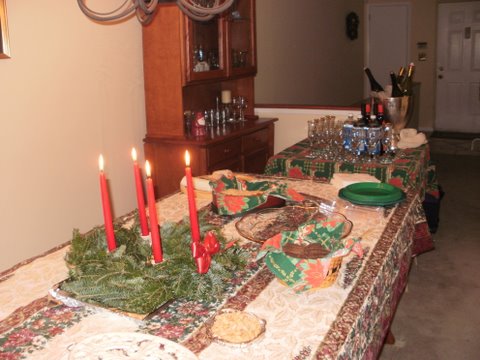
Last year's table (not so different this year)

Showing up is 80% of life.–Woody Allen

Do you ever feel like you spend most of your time showing up, without really being there?  By “being there,” I mean paying attention, being involved, feeling and enjoying that particular moment, not racing ahead in your mind to the next thing to be done.

The first time I realized someone else felt that way was years ago when I first saw “Annie Hall,” which I still think is Woody Allen’s best movie (although “Midnight in Paris” is a contender as well).  The scene where Annie and the character Woody plays are in bed, and at the same time she’s sitting on top of the bureau observing–I thought, “That’s it!”

Journalists and novelists are like that, I think, and photographers as well.  Have you ever spent so much of an event taking photos that you don’t really take part in what’s going on?  I have boxes and boxes of old-style physical photos I took in countries all over the world when I was traveling with Ron and on my own.  I look at them now and think, where was that?  What was I doing?  What was I feeling?  The camera becomes a way to create distance and put up a wall.  I think psychologists call it “compartmentalizing.”

I’ve gotten somewhat better at “being there” over the years.  Yoga class helps a lot.  I used to smirk when the teacher said, “Be here now,” but now I know the teacher means “Stop your mind from running in circles and feel where you are and how you are moving.”  Easier said that done, but it can be learned.

I think Twitter is yet another way to not be here, and texting can be as well.  Have you ever wanted to strangle a teenager who is sitting right next to you, not listening or participating in what’s going on, and texting as fast as they can to a friend?  How about the dad who can’t put down his Blackberry or iPhone?  Is every email that important?

Sorry to be such a curmudgeon.  I’ve been guilty of all the above at one time or another.  But it came home to me that being there, really being there, can be fun sometimes.  One of my friends brought his guitar to the party I gave the other night and lyrics to Christmas carols and songs.  We all sang and laughed and banged rhythm instruments for hours.  And I didn’t even realize until the next day that I didn’t get out my camera or my phone and take any pictures of the group and the party.  I was too busy having a good time!

That’s really a good way to “be here now.”