
Earliest Memories

Reading will carry us through

My book group read a fascinating book this month–not an easy read, but it led to a lot of questions and a great discussion. “Austerlitz” by W. G. Sebald was the book, a novel ultimately about a man searching for his origins and his lost family, a child of the Kindertransport.

We talked about a number of themes in the novel and how it was structured and narrated. It had a dreamlike quality, but also conveyed the destructiveness of buried memory and lost history.

One of the members of our group raised the question–what is your earliest memory? She is a psychotherapist, and she said the stories people tell about their earliest memory often encapsulate all the issues they deal with throughout their lives.

I thought this was amazing. One of our group members had clear memories of being in the hospital at age three, and how frightened and abandoned she felt. Most of us had no clear memories before age four or five.

I started thinking about it, and realized I just had an impression of emotions before I was four or five (and a clear memory of the family’s cocker spaniel, Janie, who died before I was five years old.) Between four and five I learned to read, and I clearly remember the moment when I was sitting on Daddy’s lap, looking at the Sunday comics. He was reading them to me, and I suddenly realized I knew what the words meant. It was like being struck by happy lightning! I started reading to him, and he was so proud.

Hence my lifelong love of words and books. I felt warm, safe, happy and loved, and my brain was totally charged up. I ruled the world! What could be better?

What do you remember? What is your earliest memory? I hope it is warm and happy.
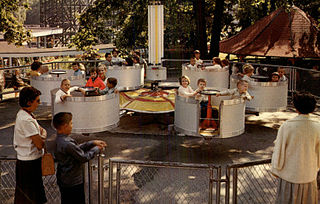
A Trip to Beech Bend Park

A similar ride at HersheyPark

Anyone who grew up in middle Tennessee or southern Kentucky is familiar with Beech Bend Park. In my childhood it was the nearest amusement park and also had a raceway. Beech Bend is where I learned that amusement park rides don’t agree with me.

This would have been in the late ’60s, I guess. I don’t remember the exact year, but I know I was not yet 12 years old. Daddy’s boss at Clarksville Base, Earl, was a college-educated engineer from somewhere in the midwest. He thought a lot of Daddy, and occassionally our family would socialize with his family. His wife was a little uptown for Mother’s tastes, but she knew better than to offend the boss’s wife. Their daughter Ruth Ann was a year younger than me. I thought she was a whiner and disliked her pretty much, but I’d been brought up to be polite, so we would play together every now and then. We all went to First Baptist Church as well.

Earl invited us to go with his family to Beech Bend Park on a Saturday. We dressed up in our best clothes that weren’t quite for church, and Daddy wore his new grey Stetson hat, sor of a pork-pie hat as I recall. The boss and family picked us up in their brand-new Cadillace, and we set off for the park.

I made it fine as long as I stuck to the carousel, the bumper cars, and the little-kiddie train which wove around a track. We ate hot dogs and cotton candy, and it was a fun day.

Then Ruth Ann cajoled me into getting into one of those spinning cup-and-saucer rides with her. I knew immediately this was a mistake. Everything whirled around, my stomach and my head went different directions, and I felt really dizzy. When the ride finally stopped I managed to walk over to my parents and try to look normal.

“Are you all right?” Daddy asked me, in Ruth Ann’s hearing. “Fine,” I said with clenched teeth over the rising nausea. I was determined to hold on.

We got into the Cadillac and set out for home. I felt worse and worse, really carsick. I was sitting in the back between Daddy and Mother. “Daddy, I’m going to be sick,” I whispered to him.

“Baby doll, you can’t be sick in this new car,” he said.

“I’m going to throw up, NOW,” I said.

“Well, get sick in this, then,” Daddy said, and handed me his new Stetson hat. I threw up in it. His boss immediately knew something was wrong–it was hard to miss. So he pulled over, and I was sick some more by the side of the road. And Daddy threw away his new hat.

Ever since then I’ve avoided amusement park rides. Disney World holds no appeal for me!

The Mystery of Owls

Growing up on a farm, I was familiar with the sound of owls calling at night.  Most owls really don’t hoot, in my experience.  Screech owls were the most frightening–they sounded332px-171_Barn_Owl[1] like a woman screaming in the woods.  Many a night I heard them shrieking to one another in the distance.

We had a tobacco barn that was about two stories high, at least.  It was used for firing dark tobacco.  There were beams running across from one side wall to the opposite wall, spaced so racks of tobacco could be hung to dry.  When it had dried enough, Daddy would build a smouldering fire with sawdust and keep it going for days, firing the tobacco.  Climbing up in the barn was perilous work but had to be done.  Usually the younger and stronger ones did that and hung the tobacco.

In the spring and summer the tobacco barn was empty, and that’s when the barn owl came to hunt mice, and sometimes just to perch.  One day Daddy called me to come with him and “see something special.”  We trudged down the rocky dirt road to the tobacco barn, trailed by my dog, Dusty.  I named him that because he was the exact color of that dirt road.

Daddy opened the smaller door within the big doors so we could go in, letting a little daylight in to the shady, cool interior.  “Look up in that corner,” he said.  There was a huge barn owl.  It slowly turned its head and stared down at us with yellow eyes.  Dusty was nosing around the dirt floor of the barn, and the owl watched him intently.  Then it spread its wings and flew out through an open hatch on the side wall.  It seemed to fly in slow motion, as if you could see every feather moving precisely.

When I saw this Audubon print it reminded me of that owl.  I can see why owls were Athena’s bird and associated with wisdom.  That level stare implies knowledge and intuition beyond what we know.

Alternate Universes, or, Not What I Had Planned

The Big Bang happens over and over again?

Yesterday I was driving around to run various errands.  I was hitting the pre-set buttons on the car radio, trying to find something worth listening to, since I didn’t have my iPod with me.  I landed on WNYC-FM, and began listening to a guy tell a story about alternate universes.  The show was from TheMoth.org, which supports storytelling of true stories by real people.

Anyway, he said that every time there is a decision or a path is taken, two universes exist at the same time–one where you said yes, another where you said no, one where you went left, one where you went right.  I think his last name was Reiser, I can’t remember.  But he told a hilarious story about how, at a time in his life when he was feeling very lost and had quit his job to “find himself”, he dreamed up this whole alternate universe in which he was a professor at Cornell.

He had all the details–married, lovely wife, two great kids, successful career, perfectly happy.  In his current life he felt very depressed by this vision, and went to his “family psychic” (his words.)  The psychic told him the rest of the story.  “You could have taken this path if you had gone to Cornell,” the psychic said.  “But then your wife would have cheated on you with your best friend and left you, taking the kids, and you would start drinking, and you wouldn’t get tenure.”  So it was just as good an alternate universe to be driving around in a beat-up Volkswagen van, having left his job as a database consultant, and not knowing what he was supposed to do with his life.

I’ve been thinking about the story ever since.  The guy really made me laugh.  But I wanted to know, is he happy now?  I think he is doing some kind of new-age thing in Boulder, Colorado (makes sense with the rest of the story.)

As Americans, we’re all about reinvention.  I can’t tell you how many people said to me, when I was out of work, “You need to reinvent yourself.”  And how badly I wanted to slug them in the nose.  I liked the me I was, and the work I did before!  But the world changes, so we have to move on.

So maybe it’s not reinvention I need.  Maybe it’s that alternate universe.  If I had called that made-for-TV-movie producer who gave me his card on the flight to NY, who owned the horse farm outside of Nashville, or had gone to school in English lit instead of business?  Or run away when I was 35?  But it would just be another story, and maybe not a happier one.

I have to think about that some more.  What about you guys?  Do you want an alternate universe?

BTW, I found the guy and his story–Tom Weiser.

In My Easter Basket

Ours were not this pretty!

When I was a child, Easter meant dressing up for church on Easter Sunday, maybe even with a hat and gloves in my youngest years.  Daddy gave each of us girls a corsage to pin to our dress.  In good years it was an orchid, and in bad years it was a carnation.  So the celebration involved spring and going to church, as we did every Sunday, but with extra accessories.

For me the best part of Easter was the Easter basket which the Easter Bunny left for me.  Mother and I would color eggs with one of those Paas kits, robin’s egg blue, bright pink, pale yellow.  But these didn’t go in the basket.  The basket was always a surprise, even when I got to be a teenager.

Mother loved any holiday and believed strongly in special food and decorations.  One year she made an Easter cake for my nephew John B. which she had seen in Good Housekeeping or some other magazine.   It was a from-scratch white cake in graduated pans like a traditional wedding cake, with coconut frosting, and little nests of coconut dyed green holding multi-colored jelly beans. It was really cute, except the cake was too “short” (i.e., full of butter or, more likely, Crisco) and the layers crumbled as she tried to frost it.  John B. loved it anyway; I think he said it was an “Easter mountain.”

Mother in her guise as the Easter Bunny got the ingredients for the basket and put them together–colored fake grass, jelly beans, and a chocolate rabbit.  The rabbit was always hollow and not huge, because chocolate rabbits were expensive.  She never had such treats when she was a child, growing up on a farm before the Great Depression.  I never questioned why the Easter Bunny used the same basket every year!

But the best treat to me was the stuffed animal.  I loved stuffed animals and collected them, sleeping with my favorites.   Even as I got older Mother got me one.  One year she let me pick it out from the offerings at this old drug store in town.  It was a rabbit, but a brown one with longer fur that looked like a real rabbit, and was soft and squishy.  I loved that one dearly.

Happy Easter to everyone.  Spring is here at last, after an awfully long winter.

Tuesday’s Child?

Mother Goose building in Hazard, KY

Do you recall that old Mother Goose rhyme?

Monday’s child is fair of face

Tuesday’s child is full of grace

Wednesday’s child is full of woe

Thursday’s child has far to go

Friday’s child is loving and giving

Saturday’s child works hard for a living

But the child that is born on the Sabbath day

Is bonny and blithe, and good and gay.

I was born on a Tuesday, and I spent many years wondering why I wasn’t a dancer, or able to walk on a balance beam without falling off.  It was a long time before I learned the rhyme might have meant a different kind of grace.  According to Merriam Webster, there are a lot of possibilities:

  1. Unmerited divine assistance given humans for their regeneration or sanctification
  2. A virtue coming from God
  3. A state of sanctification enjoyed through divine grace
  4. Approval, favor
  5. Charming or attractive trait or characteristic
  6. A pleasing appearance or effect
  7. Ease and suppleness of movement or bearing
  8. Used as a title of address or reference for a duke, a duchess, or an archbishop
  9. A short prayer at a meal asking a blessing or giving thanks
  10. Sense of propriety or right <had the grace not to run for elective office  — Calvin Trillin>

I have decided my favorite one is #8.  Just address me as “Your Grace,” and all will be well.

So, my friends, which day of the week marked your birth?  Let me know.  In case you don’t know, here’s a fun website that will calculate it for you.  And I hope you aren’t full of woe.


Love in a Cold Climate

Catrin O Ferain, from Wales

Two of my cousins got into genealogy some years ago, and delved into the Bowers family tree back to the early 1600s in Connecticut.  They then pursued a line back to England, but it turned out to be mistaken.  It’s clear, however, that the Bowers’s came from England at some point prior to that, and settled in Connecticut, and then in New Jersey, and then moved to Tennessee and stayed there for nearly two centuries.

The family is present on both sides of my immediate family–my parents were distant cousins, not unusual when you are born into a farming community in Tennessee before the Great Depression.  I’ve been thinking about it today, however, because my sister Glenda and I have both been dealing with skin cancers for several years, and no one else in our immediate family has had that problem.

We are both pale, fish-belly pale, even though we once had very dark hair.  Glenda has brown eyes, and I have light hazel eyes, like our mother’s father.  There’s a lot of environment going on, because no one in the 1800s was lying on a float in a swimming pool for hours at a time.  There’s also misguided medical practice, because I had x-ray treatment for acne when I was a teenager.

But I like to picture our foremothers (and forefathers) plowing fields in a green England under perpetually cloudy skies, or maybe cruising around in Viking boats, pale as ghosts and deadly as spectres.  It’s a comforting fantasy when the dermatologist starts to biopsy that basal cell carcinoma.  If we were still in Wales or Yorkshire or Denmark, this wouldn’t be happening.

Betty Friedan and Chocolate Leaves

Photo by Kraft
Photo by Kraft

Last week was the 50th anniversary of the publishing of “The Feminine Mystique,” Betty Friedan’s manifesto which opened the eyes of women all over the world.  Okay, I admit, I’ve never read it, but I was intrigued by the New York Times’ articles.  And as a child of the ’70s, I knew about women who immersed themselves in crazy stuff at home to fill their days and find some meaning.  It was still going on….and in some ways it still is.

The person who comes to mind is the mother of one of my college roommates.  Mrs. B was a home economics major at the University of Tennessee and got a master’s degree in textiles.  She was insanely talented as a seamstress.

Mrs. B made all Susan’s clothes, which were tailored within an inch of her life, and utterly unfashionable for the time.  Susan, to her credit, loved them.  But what 19-year-old girl in the Seventies would wear a gingham dress with a side zipper and smocking?  I borrowed it one time, and my boyfriend referred to it as “the chastity dress” because it was so hard to get off.

Mrs. B kindly volunteered to sew a raincoat for me, and told me to look at the Vogue patterns.  I have it to this day.  I picked out a Dior pattern for a balmacaan with a belt.  I lost the belt at some point, but it is so beautifully made that it is still wearable, and a classic style, of course.

The incident I was thinking of in connection with Betty Friedan, however, involved cooking.  Susan invited me home for the weekend to South Carolina.  Her parents were very fashion-forward for South Carolina if ten years behind the times–Danish modern furniture, uncomfortable plastic in the breakfast nook, Marimekko prints.  Her dad was an engineer and a kind if geeky guy.

I don’t remember what dinner involved, but I remember the dessert distinctly.  Mrs. B made parfaits, which I think involved chocolate Jello pudding and whipped cream.  But what impressed me was that each parfait was garnished with a perfect leaf made of chocolate.  Mrs. B allowed that she had experimented with several different leaves before discovering that ivy leaves worked the best, when placed on the surface of melted chocolate, peeled off, and allowed to harden.  Then she peeled off the actual leaf, and placed a perfect chocolate leaf on each parfait.

No one said, “Wow, Mom, that’s incredible!”  No one gave a single damn.  They just wolfed down their Jello parfait.  I thought my head would explode.

Maybe she was just a crazy perfectionist.  Maybe she would have done it without coming out of the environment she did.  Maybe pigs will fly.  That energy and creativity could have moved mountains.


Getting Through February

Red_Heart___1.2011Unlike T. S. Eliot, I believe February is the cruelest month.  It’s when the snows are the deepest, the winds are the coldest, and even though the days are longer, the winter seems harsh and unending.  I have a bias, too, from my youth.  Growing up in the south, spring came in March, so February was the end of winter.  Here in the north, we have at least another month of snow, wind and cold to go.

February is cruel to me, as well, because my daddy died in this month, decades ago, and my longtime companion Ron died 13 years ago today.  But bad stuff happens in every month, you know?  Good things happen as well.  My niece Judy and my sister Juanita were born in this month, and what would life be without them?

So my goal with February is to cheer myself up as much as possible, enjoy what I can, and move on.  Here are some things I recommend for these cold, dark days, and the warm hearts we all know and love.

  • Have a good cry.  See “Les Miserables” or watch a good old tearjerker on Turner Classic Movies or Netflix.  “You had me at hello.”  Hello?  My favorite:  “Enchanted April.”
  • Chocolate.  The more the better.
  • Go to a warm spot if you can afford it.  If not, take a movie holiday.  Gidget Goes Hawaiian!
  • Don’t be proud.  Call a friend if you need one, and just hang out.  DO NOT think Facebook or Twitter is a substitute for human companionship.  IT IS NOT!
  • Go shopping for something inexpensive.  This is a true story.  When Ron was in law school at Yale, he was friends with Anita Hill, a fellow law student.  I came up from Philadelphia (Wharton) to visit, and we were chatting.  She said to me, “When I want to go shopping, I go buy nail polish, because it’s pretty, and it’s cheap!”  We were all starving students then, but there is still a lesson there.
  • Hug your dog, or your cat, or your rabbit, or your hamster.  They are warm, small, and don’t understand why you are unhappy, but they still love you.
  • Re-read a book you love.
  • Read a book you haven’t read before, especially if it’s unlike anything you’ve read before.
  • Call or write someone and thank them for something nice they did for you.
  • Do something for someone else.  It’s the best way to get outside of your head.

I hope this helps.  Let me know what you think.

Bill Cunningham and the Nature of Happiness

bcny_gallery1[1]I saw a great documentary yesterday, which happens to be nominated for an Academy Award.  Bill Cunningham New York , about the photojournalist, photographer and artist Bill Cunningham.

For those of you who aren’t avid readers of The New York Times Style section, Bill Cunningham has been chronicling the uppper crust social scene with his camera for decades.  At the same time, he has been devoted to street fashion, looking for trends as he scours New York City on his bicycle.

He is now 82 years old, and still photographing the New York scene, and still riding a bike (his 29th, when the movie was filmed, because the preceding 28 had all been stolen.)  At the time the documentary was shot, he was being forced to move out of the artists’ studios over Carnegie Hall.  His could hardly be called a studio–it was more like a closet.  No kitchen, shared bathroom in the hallway.  He slept on a pallet on a board, propped up on plastic milk crates.  The tiny room was lined with filing cabinets filled with his film.  He eats cheap meals at delis ($2.50 for egg on a roll and coffee.)

After viewing the documentary at the Hastings-on-Hudson Library there was a long discussion.  I came to the conclusion (probably premature) that most Hastings residents were artistic, shrinks, or artistic people who had been to shrinks.  There was a lot of discussion of projection, repression, denial, etc.

This came about because Bill lives an ascetic life.  He has almost no possessions.  He has never had a romantic relationship.  He would not discuss his sexuality.  He has never married or had children.  He goes to Mass every Sunday.  The only moment in the documentary when he choked up was when he was asked how he felt about his religion.

He is utterly consumed by photographing the scene in New York.  He seemed to me a supremely happy person–he loves his work, and he is immersed in it, albeit to the expense of all else.  But he is happy, or at least he seemed that way to me.

So we sat on our fat middle-class asses and discussed the nature of his happiness, and some felt he was secretly sad and could not admit it.  And it seemed to me we were all wrong.  The mystery of his life is his.  And he laughs and loves what he is doing.  And he is free to do what he wants, thanks to the New York Times.  The world will be a smaller, darker place when he is gone.