
Night Visitor

When I was a child, we had a small red brick house on a winding street in town lined with other nearly identical small red brick houses.  It only had two bedrooms, so my sister Sherrie and I shared a room, and my brother Gil slept in the attic.  It was built on a little hill, so the house had a walk-out basement garage, and a separate one-bedroom apartment next to the basement, which my parents rented out for a few years.

There were wooden stairs from the kitchen to the basement and garage.  Mother stored her canned vegetables and jams on shelves down there, while Daddy kept his tools and the lawnmower there.  This was where we went when a tornado warning went out and where Daddy considered building a bomb shelter during the Cuban missile crisis (but never did.)

Usually the garage door was kept shut unless Daddy was working on something in the back yard or the parking spaces–we had room enough for two or three cars to park.  Sometimes he worked on his old truck until dark in the summertime.  It always seemed to need something done to it to keep it running.

One summer night Mother and I were watching the black-and-white TV in the living room when something flew across the room and lodged itself in the drapes.  It was so fast  I almost felt it pass more than saw it.  Mother went to the door to the basement and found it cracked open.  “George!” she called.  “I think there’s a bat in the house!”

After a few minutes Daddy came up the stairs.  “That garage door must be open and it flew up here.  Do you want the broom?” Mother asked.  “Naw, I don’t need the broom,” he said.

He pulled on a pair of heavy leather work gloves and walked over to the drapes.  I could just see a small lump near the top of their folds.  In what seemed like one quick gesture, Daddy jerked the drapes back with one hand and grabbed the lump clinging to the inside with the other hand.

“You want to see, baby doll?” he said.  I looked in his gloved hand.  It was a bat.  He had picked off the drapes so quickly that its wings had not had a chance to unfold.  It was furry and grey, looking rather like a mouse.  I touched its warm stomach with a finger.  Then it opened it mouth and showed its tiny, needle-like teeth.

“Get that thing out of here, George,” Mother said.  “It could get loose and fly at our heads!”

Daddy chuckled.  “Don’t worry, old woman,” he said.  She opened the front door for him, and he turned the bat loose, flinging it up toward the sky.  It spread its leather wings instantly and disappeared into the night.

Mother made sure the garage door and the kitchen door were closed so we wouldn’t have any more visitors.   I was glad I got to see one up close.

Vegetable Gardens and Canning Green Beans (Recipe)

Photo by Mattysc@en.wikipedia
Several of my friends buy organic food, get locally-grown produce when possible or participate in farm shares.  Some grow their own tomatoes and herbs, but no one has enough space to have a vegetable garden.

I love fresh produce that hasn’t been shipped in from Mexico or Florida (or Chile, depending on the season), but I do enjoy having fruits and vegetables year-round, whether they are in season or not.  And I am glad I don’t have to grow my own food.

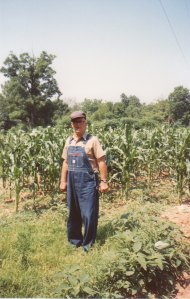
Anyone who has ever had a large vegetable garden knows it is hard work.  When I was growing up on the farm we had a garden with sweet corn, Kentucky Wonder beans, tomatoes (usually Big Boy), cucumbers, canteloupes, and yellow squash.

Daddy broke up the ground with the tractor then went through with the disc to break up the big chunks of dirt and marked out rows for us.  He put in a little fertilizer.  Then Mother and I planted everything, and it was our job to weed it and harvest what we grew.  One summer when Mother was sick Daddy and I planted the garden, and we screwed up–we put the cucumbers next to the canteloupes.  They cross-pollinated and did not bear anything.  Who knew?

Hoeing is a hateful job, especially in 90% humidity and early-morning temperatures above 80 degrees.  But it had to be done, because we did not have today’s genetically engineered crops which can be used with Roundup herbicide for no-till farming.  So we chopped out weeds as early in the morning as we could stand.  Our garden was not organic; we used a pesticide early on before the plants started bearing, or else there wouldn’t be a good crop due to the plants being eaten by insects.  Once the vegs started, the pesticide stopped, and the battle with the bugs began.

When the tomatoes came in I had many a stand-off with blister bugs when trying to pick ripe tomatoes.  Picking and shucking corn led to encounters with those big fat worms eating the end of the ears.  Some kind of wasp liked to hover around anything that flowered, like squash vines.

And the work didn’t end with picking.  Tomatoes were about the only thing that didn’t have to be prepared in some way, and Mother canned and froze dozens of quarts of beans, corn, squash and tomatoes each summer.  We also picked blackberries and froze them or made preserves and jam, picked pears from someone else’s farm and made pear preserves.  Mother even made pickles.  She had a recipe for lime pickles (made with lime–the mineral–instead of salt) which were delicious, crisp and a bit tart.  I was a largely unwilling assistant in all this.  I’ll never forget the summer we picked, broke up and canned 90 quarts of green beans.

Mother did not have a vegetable garden because it was healthy–she grew one to save money, to make sure we had good food for the winter (hence the canning and freezing) and because it was the way she was brought up.  I hated the work, but I did love the end product.

Here is a recipe of hers I just found for canning green beans.  This is a faster method than the usual cooking down to a mush for hours.  I have not tried this one!  You still have to put them in sterilized jars and make sure they seal.

Canned Green Beans

4 1/2 quarts green beans, broken

1/2 scant cup salt

1/2 cup sugar

1/2 cup vinegar

Put the salt, sugar and vinegar in a large pot with the beans, and bring to a rolling boil.  Cook about as long as you would fresh green beans you were going to eat right away.  Then put into sterilized jars and seal.

When ready to use, open a jar, pour off the liquid and season as you normally would fresh green beans.

Father’s Day: Daddy and the Whippoorwill

I get a bit sad as Father’s Day approaches every year, even though Daddy has been dead for more than 30 years now.  I still miss him.  A social worker I spoke to last week about a blog post I was writing for my job said it’s not unusual.  She said, “Feel your feelings, it’s all right to be sad.”  She also recommended doing something on Father’s Day to remember, whether it’s lighting a candle, writing a letter to your dad, or telling a story.

I remember so many things, but I decided this week to try to find a funny story.  I had dinner with some friends the other night, and we were talking about how certain kinds of birds have been singing at the top of their lungs at 3:30 or 4:00 in the morning for the last few weeks.  That reminded me of Daddy and the whippoorwill.

That was the summer our house on the farm was being built.  Daddy rented an old farmhouse from Mr. Johnny and Miss Ora, an ancient couple who lived further along the road from this house, so we moved to the country a few miles from the farm.  It was an old white clapboard house with a rickety porch.  The wood floors had cracks between the planks big enough to permit odd-looking insects to emerge on occasion.  I would not walk barefoot on those floors.

The house was not air-conditioned, of course, so we had to leave the windows open and use window fans or circulating floor fans to cool off as the summer got hotter.

The house was surrounded with old cedar trees.  There was a huge one in the back yard.  The trees made it shady most of the time, and they were a haven for birds.

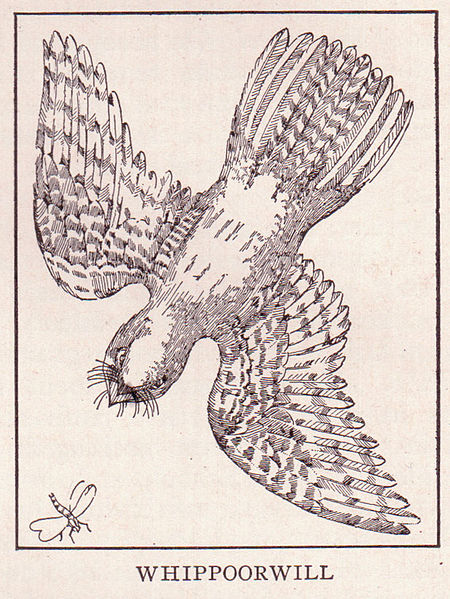
If you’re not from the South you may not know whippoorwills.  They look a bit like meadowlarks, only they aren’t as pretty–no yellow throats on them.  What they are known for, and named after, is their call.  WHIP-poor-WILL, WHIP-poor-WILL, WHIP-poor-WILL, repeated over and over and over again.  Rumor had it that they sang faster when the weather was hotter, but no one has validated that claim so far as I know (unlike crickets, of which this is true.)  You hear them sometimes in a field during the day.  But during their courting season they like to get a jump on things by singing during the night.

One night long after we were all asleep a whippoorwill began singing from the clothesline on the back porch.  WHIP-poor-WILL, WHIP-poor-WILL, WHIP-poor-WILL!  Daddy ran out to the porch and shooed the bird away, then went back to bed.

He hardly got in bed before the bird started again, this time from the big cedar tree in the back yard.  WHIP-poor-WILL, WHIP-poor-WILL, WHIP-poor-WILL!  I could hear the murmur of Mother and Daddy’s voices.  Mother probably said something like, “Leave it alone, George, and it’ll quiet down.”  But the bird went on and on.  Daddy went out in the back yard in his boxer shorts and T-shirt and yelled at the bird.  It shut up the moment he came out.  But as soon as he was back in bed it started again.

That was it.  Daddy grabbed a shotgun and ran out to the cedar tree.  I got up and looked out to see what was going on, but it was pitch black.  I did hear Mother say, “George, put that gun down, you’ll just shoot yourself!”  The bird was dead silent.  Daddy waited a few minutes, then went back into the house.

Maybe the bird sensed real danger for it must have flown out of the tree.  I heard it calling again, but at a distance, out in tree-lined field in back of the yard.  So we all went back to sleep, to the hum of the fans, and no whippoorwill calls.

Flour Sack Dresses

Photo of feed sack dress from Va Voom Vintage
When Mother was a child on a small farm in Tennessee, one of five children, times were tough.  They grew most of their food, canning vegetables, preserving fruits, smoking hams and bacon.  Mother said there were days when supper was nothing but biscuits and sawmill gravy (made from leftover bacon grease, mainly.)  Cornbread and biscuits were the staples of existence.

When she told me that her mother made dresses for them out of flour sacks, I found this hard to picture or to believe.  I thought the fabric must have been rough, like a feed sack.  Recently I did a little research, and saw that the fabric was necessarily thick and tough, to protect the contents, which were basically flour or chicken feed.  But companies were marketers back then, too, so they began to use prints which looked more like something you’d want to wear, instead of advertising Martha White.

The only good part about it is that nearly everyone in their community was in the same state, so wearing a flour sack dress did not make you conspicuous.  The only halfway affluent person was the postman and his wife–and he also farmed and sold milk.  Mother was keenly aware that there were better dresses to be had, and that her family could not afford them.  And she loved her Papa so much, she would never have said anything to make him feel bad that he could not provide for more.

Nonetheless, she was thrilled when she got a new dress one fall that was actually storebought.  She set off for school with Elsie, her best friend (who married Daddy’s brother later when they were grown up. ) Elsie admired the dress, and asked Mother to switch with her.  So she did, and Elsie arrived at school in the new dress.  I can’t think why Mother did this, as badly as she wanted a new dress.  I guess she loved Aunt Elsie more.

Air Conditioner Stories

Photo from Wikimedia
It’s above 90 degrees here today and humid in proportion.  That must be what made me remember what it was like when I was small, when we had only one window unit air conditioner to cool as much of the house as possible.

For some reason, Mother and Daddy put it in the dining room, which was in the middle of the house on Ridgeway Drive.  I guess the theory was that the air would spread out and cool the living room and the bedrooms.  Unfortunately it was not powerful enough to do that, so one of my early summer memories is sleeping with a circulating fan blowing on me.  The hum of that heavy metal fan and the sweep of air as it turned from side to side soothed me to sleep many a night.

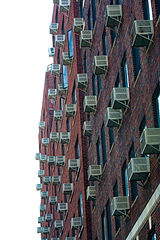
Window unit air conditioners happily left my adult life until I moved to New York in the ’80s.  I rented a fifth-floor apartment without central air, so once again I was in thrall to a window unit.  I had actually moved one with me from Atlanta which my uncle gave me–I don’t recall when I went and picked it up in Tennessee, but undeniably it moved to New York with me and was put in the window by the movers.  It was in a metal case, somewhat elderly, and extremely heavy.

It didn’t have a bracket, so I depended on the window and a few sticks of wood wedged in the sash to hold it in place.  This worked for a few weeks, but the air conditioner began to drip on the bedroom floor, which did not do the cheap wood parquet any good.  One towel per day was not enough to absorb the moisture.  Clever girl that I was, I thought I could fix this single-handed.

I took the wedges out and took hold of the air conditioner to shift it in the window.  It was much heavier than I thought and began to fall out the window.  I grabbed it.  The metal casing sliced the tips of the fingers on my left hand.  Automatically, I stomped on the air conditioner’s electric cord.  The good news was, the air conditioner hung from the window and did not fall.   The bad news was, I obviously could not pull it back in.

I looked out the window.  There were unit air conditioners in all the windows directly below mine on the fifth floor, from the fourth to the ground.  Immediately beyond the line of air conditioners was the parking lot.  I knew what I had to do.  I unplugged the air conditioner, still standing on the cord, and wrapped the damp towel around the cord.  Then I swung the cord to one side and let go.

The air conditioner fell in an arc, landing in the grass just next to the parking lot.  It did not graze any other air conditioners or take out any cars.  I was exhausted with relief.  I called the security guard and told him what I’d done.  When he stopped laughing, he said they would clean it up the next day.

Then I realized I was bleeding all over the place.  I knocked on my neighbor’s door and assured her I wasn’t dying despite the blood.  Hands and heads bleed a lot.  My neighbor took me to an emergency room.  Fortunately the cuts were not deep, although the process of cleaning them was not pleasant.  I have a little scar on my thumb to this day.

The next day I called my friend Kathy in Atlanta to report my adventure.  She laughed until she coughed for breath.  For months after that when we spoke, she would ask, “Thrown any small appliances out the window this week?  Not even a toaster?”

Visiting Aunt Lou and Uncle Floyd

Uncle Floyd
What follows is an exercise I wrote for a class several years ago.  We were to remember a time and place that was lost to us, and write all we could remember.  So I did:

We drive up the blacktop road toward  sunset, my parents and I, the old Ford pickup laboring up the hill.  Turning into my uncle’s gravel driveway kicks up a small cloud of dust.  The truck wheezes to a halt, and the dust settles as we climb out and walk to the house.

Across the blacktop road from the house is a tree-lined field  with cattle grazing quietly in the dusk.  They are a motley bunch, a mix of  Herefords and Holstein crosses, too bony for good beef cattle, too stocky for good dairy cattle.  My aunt’s little Jersey is the only princess, with her fawn-colored coat, her delicate hooves, her big brown eyes.  Aunt Lou keeps the milk cow so she can churn her own butter; she thinks it’s better than store bought.

At the side of the yard is my aunt’s garden.  Honeysuckle spills over the woven wire fence, scenting the humid air.  The first two rows of the garden are flowers:  zinnias, marigolds, snapdragons, daisies.  The rest is food for the summer, and for preserving:  beans, corn, squash, tomatoes, cucumbers for pickles, canteloupes, watermelons.

In the shade of the back yard, past the chicken coop, is her mother-in-law’s wildflower garden.  Miss Blanche transplants sweet william, violets, and trillium from the woods, watering them faithfully. Their colors are paler and more delicate than the sunny flowers in the other garden.

Tall, old oak trees and maples shade the back yard and the front yard during the day.  Now that the sun is slouching down below the hill, birds rustle the branches as they settle in for the night.  They fuss and squabble in the trees.

The old clapboard house is painted white; the tin roof is shiny.  There’s a dogtrot hall running through the middle, with a couple of large rooms on either side and a kitchen in the back.  For many years there wasn’t a bathroom.

On a summer night the most important room is the front porch.  This is where we all sit and talk while night falls.   There is a porch swing, where I sit with Miss Blanche, and two wooden rocking chairs for the two men, tired from a long day in the fields.  My mother and Aunt Lou sit on metal chairs in the front yard, hoping for a breeze.

The women’s voices are low and even.  The men rumble in baritone, punctuated by my father’s laugh.  Miss Blanche and I are quiet as it grows dark, waiting for the tree frogs to begin their high piping.  Lightning bugs blink erratically  in the yard.  The humidity settles in the hollow like a ground fog.

“Look,” Miss Blanche says.  A deer broaches the mist in the hollow, sights us, and floats away into the dark.

Soon, the moon will rise above the hills.  It is time to go home.

My Mother’s Shadow

Mother
Several years ago my niece Judy found an old camera with film in it at my sister Glenda’s house in Ohio.   My brother-in-law John bought it in Japan while he was in the Navy during the Korean War.  It took color photos, which wasn’t common at the time among amateurs—this was some time before Instamatics and Kodachrome.

Judy took the camera to a camera shop, where they removed the film safely and developed it.  She gave me a framed 5×7 print of one photo for Christmas that year.  (I wanted to scan it for this blog post, but the print has stuck to the glass of the frame, so I can’t remove it without damage.)  It’s the only color picture I have of myself as a small child.  I look about two years old, still a bit babyish, in a dress and white baby shoes, with pudgy arms and legs and a round face.  I am wearing an expression my friends all recognize to this day as, “I’m playing along with you because I have to, but you are trying my patience severely.”

This must have been a family outing of some sort since John and Glenda were there, and at that point we all lived in Clarksville, Tennessee, 40 miles away.  I’m standing alone on the steps of the Confederate Memorial in Centennial Park in Nashville.  It’s summer, and I will be three years old in the fall.

At the corner of the photo is my mother’s shadow, stretching over the steps close to my feet.   She has a middle-aged figure, stout around the waist, and is wearing a bucket-shaped hat with a brim.  Her shadow leans toward me.  Mother is not reaching out to keep me from falling, but one feels that the moment the picture is taken she will sweep me off the stairs to safety.

Mother was afraid of many things, I learned as I grew older.  Glenda said Mother was terrified that I would die as a baby, because she had had a miscarriage between my brother and me and because she was an “older mother”—all of 38 years old when I was born, the last of five children over a span of 19 years.  She hardly let me out of her sight.  Glenda said at one point I broke out in a rash, and Mother took me to the pediatrician.  He said, “There’s nothing wrong with her.  You’re making her so nervous she broke out.”

I spent most of my life convinced I was utterly unlike my mother in every way.  I was rational, she was emotional.  I was calm, she was nervous.  She used to say, “You’re just like your daddy,” and I was proud.  I tried to practice being the strong, silent type like him.  I found it hard to say what I felt.  But as I grew older I realized I wasn’t calm, I was just pretending to be calm.  I was rational, but I had emotions too.

Mother died in 2004 after many years of illness and devoted care from Glenda.  I miss her on Mother’s Day especially.   No matter how old I get, her shadow is still there, on the edge of the picture.

Recipe: Juanita’s “Rocks” Cookies

Rocks Cookies
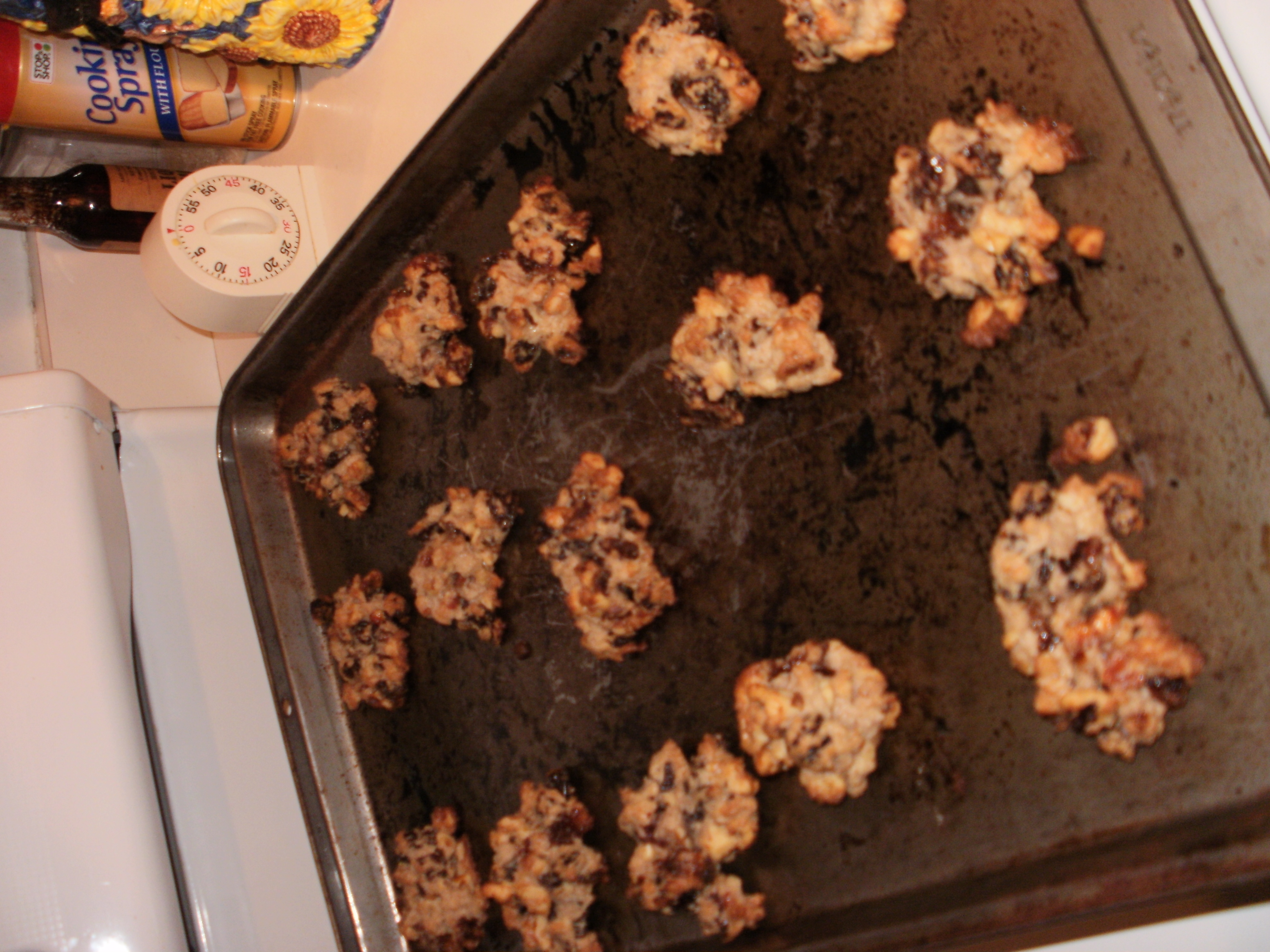
Rocks cookies fresh from the oven

This recipe actually comes from my sister Juanita’s neighbor, whose mother made them in rural Pennsylvania.  Juanita sent me some at Christmas last year, and I liked them because they have that Christmas smell (see last week’s post).  Also they will keep for a week or two in a tightly closed plastic container, which is a plus sometimes, and they freeze well.

Anyway, I thought of them when I needed to make cookies for my book group, so I called Juanita and got the recipe.  When I baked them, they didn’t rise, and they cooked faster than planned.  Hmm, I said to myself, and called my sister Glenda.  Glenda said, maybe it’s because you used a dark cookie sheet?  Then she read the recipe to me, to make sure I had it all.  Woops!  I had left out the baking soda.

End of the story:  even without baking soda, they tasted fabulous.  So I took them to book group, and they snarfed them down, and requested the recipe.   Juanita called afterwards for a report, so I had to admit my mistake.  She laughed, and said the first time she made them, they ran all over the pan.  Her neighbor forgot to mention the flour when she gave her the recipe!

So here’s the deal.  If you want them the way they are supposed to look, and with the texture they are supposed to have (a little bit puffy and cakey), follow the recipe precisely.  If you have dark cookie sheets, lower the temperature by 25 degrees!  If you want them chewy and not puffy, leave out the baking soda.  It works just fine.  Also, this recipe can be halved.  It makes an inordinate amount of “rocks.”  P.S.  For some reason, this image will not rotate!  Makes me crazy.  Just turn your head sideways to see what the non-baking-soda version looks like.

“Rocks” Cookies

1 cup butter

1 cup sugar

4 eggs

3 cups regular flour

1 lb. each of chopped dates, raisins, and chopped walnuts

1/2 teaspoon each of allspice, cinnamon, nutmeg and salt

1 teaspoon baking soda, dissolved in a little hot water

Cream butter and sugar.  Add eggs.  Add dry ingredients and baking soda (batter will be stiff).  Fold in the dates, raisins, and walnuts.  Drop by spoonfuls onto ungreased cookie sheets.

Bake at 350 degrees for 15-20 minutes (if using dark cookie sheets, bake at 325 instead).  Makes 5 – 6 dozen.

1

Sunday Mornin’ Comin’ Down

Do you know the old Kris Kristofferson song, “Sunday Mornin’ Comin’ Down”?  The lyrics are really poetic in a country kind of way.  He paints a sharp picture of what it’s like to wake up in a “sleeping city” (probably Nashville) with a terrible hangover and yet sharply observe the Sunday morning.

Part of that description is the “Sunday smell of someone frying chicken,” which takes the singer back to “something left behind.”  Smell is powerful at evoking memories, perhaps more powerful than any other sense.

I spent this Sunday morning baking cookies, not an activity I often pursue, and the scent of the cookies took me back to Mother baking at Christmastime.  The recipe was from my sister Juanita–I will share it if she permits, but not today–and called for nutmeg, allspice and cinnamon, as well as chopped dates, raisins and walnuts.  Something about the spices and the scent of dried fruit baking reminded me of Mother making a blackberry jam cake which used the same spices.

That was a three-layer cake iced with boiled icing.  Some people think a jam cake is just another fruitcake, but it doesn’t have those nasty candied fruits.  And when it is baking, the house smells of those Christmas spices and baking blackberries.

Thinking of Mother reminds me of another scent.  When I was young she always used perfumed dusting powder on her thighs and arms and chest.  She said it kept her from chafing.  I can’t remember what kind it was, although I faintly remember a pink round box with gold trim and a flat white pad instead of a powder puff.  I do remember a strong flowery scent with a bit of baby powder smell as well.  She was fond of Estee Lauder when she got older, but I don’t think we could afford that back in the day.  I wish I could smell it again.

So another Sunday is winding down.  Here’s to a good week, to all of us on sleeping city sidewalks, bustling suburban highways, and quiet villages.  Peace out.

Dick Clark: Thinking Back About Pop Music

Lovin Spoonful, 1965
Like so many people, I was sad when Dick Clark passed last week.  I saw many pop groups for the first time on “American Bandstand,” only to see them appear later on “The Ed Sullivan Show” or “Hootenany” (anybody remember that one?).  In the ’70s, I’ll admit I switched my allegiance to “Soul Train” (rest in peace, Don Cornelius!) but I still watched Bandstand fairly often.

Thinking about the wide variety of groups and solo artists who performed on American Bandstand led me to remember the first records I ever bought.  Do you remember your first purchases?  Mine were 45’s, argh!  (At least they weren’t 78’s.)  And they were:  “Do You Believe in Magic,” by the Lovin Spoonful; “The In Crowd,” Ramsey Lewis Trio; and “Nineteenth Nervous Breakdown,” the Rolling Stones.  I don’t remember what the B sides were.

Now, that’s an eclectic selection, is it not?  Pop/soft rock, jazz and serious rock ‘n roll.  If you looked at my iPod today you’d find pretty much the same mix, but with a large playlist of roots and old country music, another of indie rock, and a nice selection of Brazilian sambas and Carnival music, a liking inspired by a trip to Rio in the early ’90s.

Times and tastes change, but what these all have in common is melody and a beat.  I’ve always liked singer-songwriters, too.  Ah, the moody albums of college days!  But for every Joanie Mitchell I listened to, I also played the Allman Brothers’ “Eat a Peach.”  (OK, I confess, my first album was “The Monkees,” from my brother as a Christmas present.  I wanted it badly.)

Now I listen to WFUV, Roots and Rock Radio (Fordham University public station) as I drive to work, and get my dose of Lyle Lovett and the Alabama Shakes early in the morning.  And a couple of weeks ago I got to see Nora Jones at the Music Hall in Tarrytown.  I am far from the cutting edge in musical taste.  But a good song still gives a lot of pleasure.  And a good pop song still bores into my brain.  “Moves Like Jagger,” anyone?