Vegetable Gardens and Canning Green Beans (Recipe)

Photo by Mattysc@en.wikipedia
Several of my friends buy organic food, get locally-grown produce when possible or participate in farm shares.  Some grow their own tomatoes and herbs, but no one has enough space to have a vegetable garden.

I love fresh produce that hasn’t been shipped in from Mexico or Florida (or Chile, depending on the season), but I do enjoy having fruits and vegetables year-round, whether they are in season or not.  And I am glad I don’t have to grow my own food.

Anyone who has ever had a large vegetable garden knows it is hard work.  When I was growing up on the farm we had a garden with sweet corn, Kentucky Wonder beans, tomatoes (usually Big Boy), cucumbers, canteloupes, and yellow squash.

Daddy broke up the ground with the tractor then went through with the disc to break up the big chunks of dirt and marked out rows for us.  He put in a little fertilizer.  Then Mother and I planted everything, and it was our job to weed it and harvest what we grew.  One summer when Mother was sick Daddy and I planted the garden, and we screwed up–we put the cucumbers next to the canteloupes.  They cross-pollinated and did not bear anything.  Who knew?

Hoeing is a hateful job, especially in 90% humidity and early-morning temperatures above 80 degrees.  But it had to be done, because we did not have today’s genetically engineered crops which can be used with Roundup herbicide for no-till farming.  So we chopped out weeds as early in the morning as we could stand.  Our garden was not organic; we used a pesticide early on before the plants started bearing, or else there wouldn’t be a good crop due to the plants being eaten by insects.  Once the vegs started, the pesticide stopped, and the battle with the bugs began.

When the tomatoes came in I had many a stand-off with blister bugs when trying to pick ripe tomatoes.  Picking and shucking corn led to encounters with those big fat worms eating the end of the ears.  Some kind of wasp liked to hover around anything that flowered, like squash vines.

And the work didn’t end with picking.  Tomatoes were about the only thing that didn’t have to be prepared in some way, and Mother canned and froze dozens of quarts of beans, corn, squash and tomatoes each summer.  We also picked blackberries and froze them or made preserves and jam, picked pears from someone else’s farm and made pear preserves.  Mother even made pickles.  She had a recipe for lime pickles (made with lime–the mineral–instead of salt) which were delicious, crisp and a bit tart.  I was a largely unwilling assistant in all this.  I’ll never forget the summer we picked, broke up and canned 90 quarts of green beans.

Mother did not have a vegetable garden because it was healthy–she grew one to save money, to make sure we had good food for the winter (hence the canning and freezing) and because it was the way she was brought up.  I hated the work, but I did love the end product.

Here is a recipe of hers I just found for canning green beans.  This is a faster method than the usual cooking down to a mush for hours.  I have not tried this one!  You still have to put them in sterilized jars and make sure they seal.

Canned Green Beans

4 1/2 quarts green beans, broken

1/2 scant cup salt

1/2 cup sugar

1/2 cup vinegar

Put the salt, sugar and vinegar in a large pot with the beans, and bring to a rolling boil.  Cook about as long as you would fresh green beans you were going to eat right away.  Then put into sterilized jars and seal.

When ready to use, open a jar, pour off the liquid and season as you normally would fresh green beans.
Recipe: Juanita’s “Rocks” Cookies

Rocks Cookies
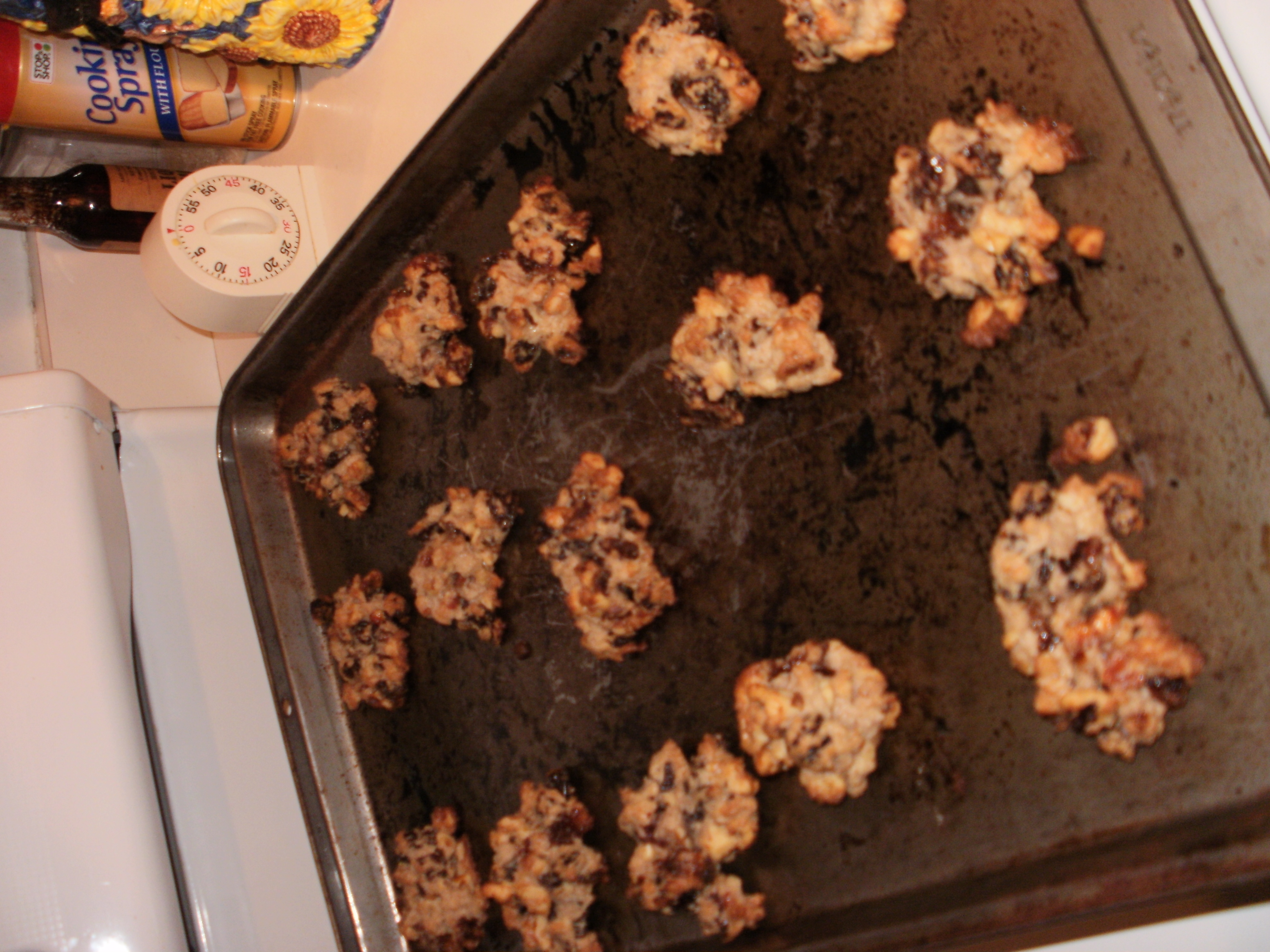
Rocks cookies fresh from the oven

This recipe actually comes from my sister Juanita’s neighbor, whose mother made them in rural Pennsylvania.  Juanita sent me some at Christmas last year, and I liked them because they have that Christmas smell (see last week’s post).  Also they will keep for a week or two in a tightly closed plastic container, which is a plus sometimes, and they freeze well.

Anyway, I thought of them when I needed to make cookies for my book group, so I called Juanita and got the recipe.  When I baked them, they didn’t rise, and they cooked faster than planned.  Hmm, I said to myself, and called my sister Glenda.  Glenda said, maybe it’s because you used a dark cookie sheet?  Then she read the recipe to me, to make sure I had it all.  Woops!  I had left out the baking soda.

End of the story:  even without baking soda, they tasted fabulous.  So I took them to book group, and they snarfed them down, and requested the recipe.   Juanita called afterwards for a report, so I had to admit my mistake.  She laughed, and said the first time she made them, they ran all over the pan.  Her neighbor forgot to mention the flour when she gave her the recipe!

So here’s the deal.  If you want them the way they are supposed to look, and with the texture they are supposed to have (a little bit puffy and cakey), follow the recipe precisely.  If you have dark cookie sheets, lower the temperature by 25 degrees!  If you want them chewy and not puffy, leave out the baking soda.  It works just fine.  Also, this recipe can be halved.  It makes an inordinate amount of “rocks.”  P.S.  For some reason, this image will not rotate!  Makes me crazy.  Just turn your head sideways to see what the non-baking-soda version looks like.

“Rocks” Cookies

1 cup butter

1 cup sugar

4 eggs

3 cups regular flour

1 lb. each of chopped dates, raisins, and chopped walnuts

1/2 teaspoon each of allspice, cinnamon, nutmeg and salt

1 teaspoon baking soda, dissolved in a little hot water

Cream butter and sugar.  Add eggs.  Add dry ingredients and baking soda (batter will be stiff).  Fold in the dates, raisins, and walnuts.  Drop by spoonfuls onto ungreased cookie sheets.

Bake at 350 degrees for 15-20 minutes (if using dark cookie sheets, bake at 325 instead).  Makes 5 – 6 dozen.

1

Recipe: Spiced Lentil Soup

Now that we’re back to cooler spring temperatures (although still above normal), I decided to make a pot of this soup today.  This recipe comes from an old Prevention magazine Slow Cooker Meals cookbook.  I have had it for a long time, but had not tried this recipe until this winter.

If you like Indian food, you will love it.  If not, stay away–it is very spicy!  To me, that’s a virtue, especially when my nose is running and my ears are stuffed up from all this early and abundant pollen.  Another great thing about it is it can cook all day on low, so it’s safe to leave in the slow cooker even if you have a lengthy commute.  The recipe says it makes 4 servings, but I think it makes considerably more than that.  I tend to freeze it in 2-cup containers for nights when I don’t feel like cooking or days when I want to take something microwaveable for lunch.

Spiced Lentil Soup

1 cup lentils, rinsed

1 can (28 oz.) stewed tomatoes, undrained

2 medium potatoes, diced

2 medium carrots, sliced

1 medium onion, chopped

1 rib celery, sliced

3 cloves garlic, minced

3 bay leaves

1 tsp freshly ground black pepper

3 Tablespoons curry powder

1 tsp ground cumin

1 tsp ground coriander (in Asian groceries; if you can’t find, it’s ok without)

4 cups low-fat, low sodium chicken or vegetable broth

Combine all ingredients in slow cooker.  Cover.  Cook on low 8 to 10 hours or on high 4 to 5 hours, or until lentils are tender.  Remove bay leaves before serving.

Makes 4 servings, per serving 260 calories, 14 g protein, 51 g carbs, 15 g fiber, 930 mg so

Recipe: Original Red Velvet Cake

Red velvet cake was not part of my holiday tradition in middle Tennessee.  My mother made blackberry jam cake every year, and I’d never heard of red velvet cake until Ron made it for my Christmas party here in New York.  After he died, Linda graciously assumed the mantle and has made red velvet cake every year since for the party.

It’s really a chocolate pound cake with cream cheese frosting.  What makes it red is a ton of food coloring.  Linda has tried everything from beet juice to all-natural coloring, but nothing gets that lurid red except regular food coloring.  If the thought of Red Food Dye #whatever bothers you, just use one bottle instead of two.

This recipe is a little retro–I think it dates from the ’60s if not earlier.  Now that red velvet cake and cupcakes are popular, I’m sure there are many variations.  But this is the one I know and love.  Happy Christmas from me, and a shout-out to the memory of Ron.

Red Velvet Pound Cake

3 cups cake flour

1/2 cup cocoa

1/4 teaspoon baking powder

Sift together the dry ingredients.

Then mix:

3 cups sugar

5 eggs

1 teaspoon vanilla

2 1-ounce bottles of red food coloring

1/2 cup Crisco

1/2 lb. butter

1 cup milk

Mix the dry ingredients into the wet mixture.  Bake in a tube pan 1 1/2 hours at 300 degrees.

Icing:

1 8 oz. package cream cheese

1 box powdered sugar

1 stick butter

1 cup pecans (small pieces)

2 tablespoons vanilla

P.S.  I got the photo from Wikimedia for a “Southern red velvet cake.”  I never think to take a picture of Linda’s–too busy eating!

Recipe: Mother’s Cornbread

My  mother’s favorite cornbread recipe was not the traditional one she grew up with.  That one used only cornmeal, probably like a johnny cake, with bacon grease, salt and boiling water.  It was the cheapest type of food.  Mama, Mother’s mother, would make this kind of cornbread to feed the hounds when there weren’t enough table scraps.  When times were better the recipe incorporated an egg.  Here is a recipe for that type, credited to Alison Krauss, from the Martha White website: http://marthawhite.com/Recipes/Detail.aspx?recipeID=2564&mealtype=26

What follows is the recipe written in Mother’s handwriting, labeled “one I use.”  It’s my favorite too, if not for purists, or for us lazy slobs who use cornbread mix (Martha White might quarrel with me there).

Mother’s Cornbread

1 cup sifted flour

1 cup cornmeal (yellow preferred, but white is ok)

1 to 2 tablespoons sugar (your preference)

3 teaspoons baking powder

1 teaspoon salt

2 eggs well beaten

1 cup milk

1/4 cup corn oil (or canola would work)

Sift dry ingredients together.  Add egg, milk and corn oil.  Bake in an iron skillet in a 425 degree oven for about 30 minutes.

Recipe: Aunt Geneva’s Coconut Pie

Aunt Geneva was my mother’s youngest sister.  She was feisty and funny.  In her young days, she pushed the boundaries of behavior in their country community before World War II.  Aunt Geneva smoked, and drank when she got the chance.  She and their brother, Uncle Jesse (known as Fatty because he was so thin), played harmonica and guitar and sang at parties, which was expressly forbidden by their hard-core Baptist church.   Mother told me it was permissible to sing, but not to play instruments at a “play-party.”  They also were not allowed to play cards except for Rook and Old Maid.

Aunt Geneva was the only one of the sisters to learn to drive a car, work outside the home, and marry someone outside of the community.  She continued to work at a plant that manufactured shoe soles while raising two boys.  I was always happy when she came down to visit Aunt Lou because Uncle Fatty would come over with his guitar, and they would play and sing the old songs, as well as “Little Brown Jug,” “Froggy Went A-Courtin'” and “In the Pines.”

Here is the recipe for Aunt Geneva’s coconut pie.  It is not a coconut cream pie, but a dense, sweet, custard pie, and very easy to make.

Geneva’s Coconut Pie

1 cup sugar

1 cup milk

5 tablespoons flour

dash salt

2 or 3 eggs (2 large, or 3 smaller)

1 teaspoon vanilla

1 can coconut (or 1 cup flaked coconut)

1/2 stick butter

Mix all ingredients.  Bake in unbaked pie shell at 350 degrees about 45 minutes.

Chess Pie: Nothing But Sweet

Photo by Eunice from Flickr

When I was a child, chess pie was my favorite dessert.  Chess pie is a phenomenon of Tennessee and perhaps Kentucky.  It is not subtle.  It is rich and sweet and buttery.  It has some characteristics in common with caramel pies, but the flavor and texture are different.  It is not subtle or savory.  It’s just teeth-stickingly sweet.

As the youngest of five children sometimes I got lost in the shuffle.  Mother was convinced that chess pie was my brother Gil’s favorite (true) and that mine was something else (not true).  One time I came home from college to Aunt Geneva’s coconut pie, which was excellent, but far down my list of favorites.  I’ll never forget how hurt Mother looked when I told her she baked the wrong pie for me.  That was part of our relationship, I’m afraid–she came up with something that wasn’t personal to me, and I punished her for it.  Not very kind of either of us.  Mothers and daughters often are not much fun, but sometimes we learn from our experiences.

Once she got the message I got my chess pie.  I don’t know where the name came from or its history, but it goes back a long way in the middle South.  It must have been a luxury when sugar was in short supply.  My brother gave the recipe to the mess cook in South Carolina when he was in the Air Force, and introduced it to a number of hapless Yankees as well as Southerners.

Chess Pie

1 1/2 cups sugar

1 teaspoon cornmeal

1 teaspoon flour

1/4 cup milk

2 eggs

1/2 stick melted butter

1 teaspoon vinegar

1 teaspoon vanilla

1/2 teaspoon salt

Mix and pour into unbaked pie shell.  Bake at 350 degrees for 40 – 45  minutes or until firm when pressed lightly in the middle.

Emergency Dessert: Mother’s One Egg Cake

I don’t remember exactly when this photo of my parents was taken, sitting in the swing in the front yard of our house on the farm.  Daddy always wore khaki work clothes to his job at Fort Campbell and also to work around the farm.  Mother thought overalls were low-class, so he never wore them.

Daddy worked hard on the farm, and his job at Fort Campbell in his later years was demanding, too.  I can’t imagine a man in his 50’s unloading frozen sides of beef  and carrying them into the commissary meat locker, but that’s what he did.  Mother felt he needed meat and vegetables every night for dinner, and Daddy felt he needed a dessert as well.

Money was always tight, but we had our own beef and pork, generally one of the yearling calves and one pig that were slaughtered and frozen.  Mother canned and froze vegetables from our garden and apples and pears from various relatives’ trees, and made jams and jellies.  So we always ate well, thanks to her labor (and mine, an unwilling helper!).

The following recipe is the one egg cake she would make when she didn’t have a lot of eggs to spare and not a lot of time.  She generally served it with fruit or ice cream, or made a quick buttercream frosting.  I’ve used  it instead of shortcake with strawberries and whipped cream, or just dusted some powdered sugar on top and called it a day.  It makes a 8″ x 8″ or 9″ x 9″ one-layer cake, just right for four people.

One Egg Cake

2 cups flour

3 1/2 teaspoons baking powder

1/2 teaspoon salt

1 cup sugar

1 egg

1 cup milk

1 teaspoon vanilla flavoring

2-4 tablespoons shortening

Cream together shortening, sugar, egg, vanilla, and milk, then add dry ingredients and mix.  Bake in greased 8″ x 8″ or 9″ x 9″ pan in 350 degree oven (325 degrees if using glass baking dish) for 25 – 30 minutes.  It’s done when lightly browned and center bounces back if you touch it lightly.

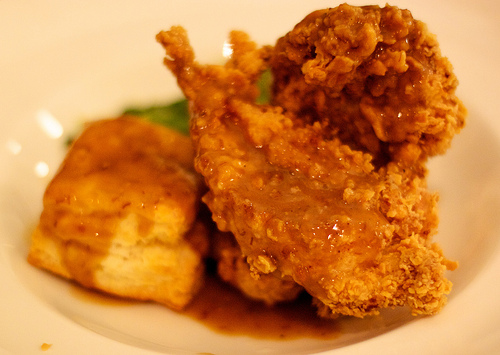
Almost Perfect Fried Chicken

Photo by Niall Kennedy

This recipe comes from my mother’s Sunday School class cookbook, produced about 25 years ago.  It used to make absolutely foolproof, perfect fried chicken.  However, times have changed–and the timing of this recipe needs to change unless you are using a small chicken, what used to be called a “fryer.”  I have discovered that today’s super-sized chickens (I’m talking to you, Frank Perdue, and your son, too) take longer to cook, especially the egregiously oversized breasts.

What follows is the ORIGINAL RECIPE.  If using a larger chicken or pieces, which tend to be thicker, add 2 minutes to each side, and leave the split breasts in for another 5 minutes or more.  Cut into the meat and see if the juices run clear.

So the recipe is not as easy as it used to be.  But it still works, if you use a small freerange-type chicken or adjust the timing.

Sunday School Class Fried Chicken

Clean and cut a whole chicken ready to fry (or buy pieces).  Place in cold water and let set about 3 – 5 minutes.  Pat the pieces dry.  Salt the chicken and roll in flour.  Add a little black pepper if you like.

Meanwhile, heat shortening in a deepish skillet (Crisco is good, or oil, or lard if you’re a purist).  When it’s hot (a drop of water will make the oil sizzle), put the chicken in.  Cook on medium heat 5 minutes with a lid ON the skillet.  Then remove the lid and cook for 4 minutes with the lid OFF.

Turn the chicken pieces and place the top on; cook for 5 minutes.  Then remove top and cook for 4 minutes.  Should be done, crispy but moist inside and not pink.  As noted above, modern breasts and thighs MAY TAKE LONGER!

Fish Recipe: It’s Not All Southern-Fried

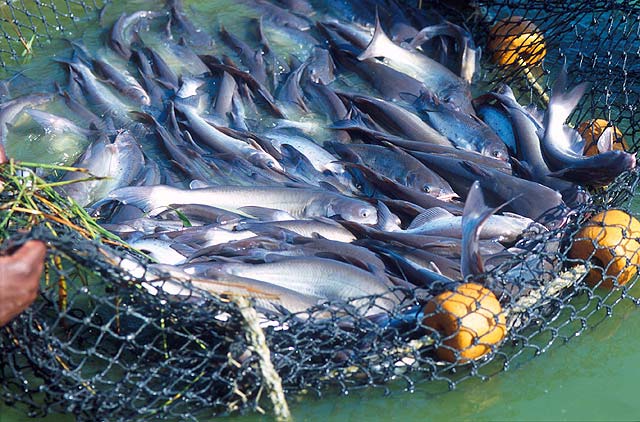
Farmed Catfish, photo by USDA
The fish dinners I grew up with were all fried, sometimes deep-fried filets of bass and sunfish (yum!) and sometimes pan-fried, cornmeal-crusted chunks of catfish, both caught in the Cumberland River by an uncle or a cousin.  Mother always had to hide her chagrin when my cousin showed up with a huge river catfish.  Yes, it was free meat, but catfish are bottom feeders, so a Cumberland River catfish tasted strongly of diesel fuel.

Nowadays I only get fried catfish when I go back to Tennessee to visit.  It’s farm-raised, so the taste is light and fresh.  I learned to love fish over the years prepared a lot of different ways.  Recently I experimented with some fish filets.  The end result was very easy and very good, two of my criteria for cooking.  Here’s the result.

Salsa Verde Fish Filets

1 1/2 lbs. halibut, cod, catfish or other white fish filets

1/4 teaspoon salt

2/3 cup salsa verde or tomatillo sauce (i.e., green salsa)

1/2 cup sliced black olives

3-4 tablespoons chopped fresh cilantro leaves

Fresh ground black pepper to taste

Preheat oven to 350 degrees.  Spray 13″ x 9″ baking dish with vegetable oil or grease with 2 tablespoons olive oil.  Place fish filets in a single layer in the dish.  Sprinkle with salt and top with salsa verde.

Bake uncovered 20 -30 minutes or more until fish is done (flakes easily with a fork).  Garnish with olives and cilantro.

Makes 4 servings.

This is good with rice to soak up the sauce!