Any of us whose parents live to be elderly are likely to experience their long, sad decline at the end of life. I’ve had both extremes–Daddy died suddenly at a relatively young age, of a heart attack, while Mother spent a couple of decades with heart failure and then strokes. Even when you’ve had lots of time to prepare it always comes as a shock. How can they be gone? How will my life go on?
Scott Simon, an NPR host and former Today show weekend host, went through this with his mother in Chicago. He tweeted throughout her time in the ICU, until she died, and after, an online journal of his thoughts and feelings in 180 characters per message. If you haven’t read them, here is a link: https://twitter.com/nprscottsimon
I’m a bit disturbed by the concept of typing on a smartphone while your mother is dying, but his writing and emotions disarm that. He held her in his arms, sang to her, listened to her while she could still talk.
When I worked for a hospice agency I was told the most important things to say when you’re saying goodbye are: I love you, please forgive me, I forgive you, thank you. Sometimes a parent needs to hear you say, “It’s okay for you to go, I will be all right.” Mothers are still mothers, even on their deathbeds. One nurse told me that sometimes the mother will wait to die until the children are out of her room. “I think some of them want to spare the children, right to the end, ” she said.
It’s important to know when to let go, and to get the help you and your parent need. Facing the end is terrible, but anyone who has mourned a dying person knows the truth: we’re not mourning for them, we’re mourning for us and our loss.
My mother was always fond of flowers. Wherever we lived, she planted bulbs and weeded flower beds. Our yard was never elaborate or manicured, and she certainly never read gardening books or drew plans. But I remember four o’clocks which bloomed in the evening shade, and beds of zinnias and marigolds scorching in the summer sun. She planted tiger lilies on the edges of the back yard at the house we lived in when I was in elementary school and phlox clinging to a rocky outcropping by the kitchen door.
When we moved to the farm someone gave Mother several varieties of irises. Some of them were the classic purple ones which are the state flower of Tennessee. Others had huge blossoms in unusual colors, including peach. They were the last of the bulbs to bloom each spring (technically speaking, they grew from rhizomes) and gave us a week or two of glory before the heat set in. In order to keep them blooming year after year, the rhizomes have to be thinned out. Mother gave some to my sister Sherrie, who planted them in her yard. As recently as three years ago they were still blossoming.
I’m not sure how some of Sherrie’s rhizomes got to my niece Judy in Ohio, but they did. The photo is of a peach-colored iris blooming in Judy’s yard this spring. She has two plants that still come up and flower, descendants of the original stock that was planted in the late ’60s on our farm. Out of those roots….maybe they will last long enough to provide rhizomes for another generation, another yard, more springs.
A modern-day air conditioning unit in Vicksburg, MS
My friend Ed observed the other day that the two forces which made the modern South possible are integration and air conditioning. The more I think about that statement, the truer it becomes. We obviously still have huge issues with racial tensions throughout this country–the sad case of Trayvon Martin makes that only too clear. Yet, as my African-American friend has told me before, things are a whole lot better than they were 50 years ago. I hope we can get still further down that road.
On the subject of air conditioning, the heat and humidity of this summer has led me to remember what it was like in the summer in Tennessee. When I was a small child we only had a big unit air conditioner in the dining room window, which was supposed to cool the entire house. It was not nearly big enough, so we had circulating fans on the floor in our bedrooms. The rhythmic hum of the fan was as good as white noise to help me fall asleep, while the movement of air washing over me made me feel cooler.
On the worst nights, when the air conditioner just couldn’t cool enough and the air was thick with humidity, Daddy would get out the car and we would go for a ride after dark with the windows rolled down. The sticky air didn’t help much but the breeze coming through the windows was better.
We spent one summer in an old, dilapidated house without enough wiring for air conditioners while the house on the farm was being built. It had thick walls which did keep it from heating up as much as it would have otherwise. But many a night I laid in bed, sheets thrown off, sweating even with a fan pointed at me from the floor.
Air conditioning in modern office buildings made it possible for industry to move to the South, which made city life and civilization preferable to farming for many people, and brought diverse populations to the area. Air conditioning in homes made it much more comfortable to live there. It was a big change which I am grateful for, even here in New York–the third heat wave of the summer began yesterday!
I went with some friends to a park in Hastings today to see the Moving Wall. It was an extremely hot day, but another friend who is a Vietnam vet was volunteering at the traveling exhibition, and his wife was working it as well. So we drove down in air-conditioned comfort to view it.
The Moving Wall is a half-size replica of the Vietnam Veterans Memorial in Washington, DC and has been touring the country for almost 30 years. Even at half size it is somber and sobering. All those names, starting in 1959 and going forward year by year–it’s overwhelming in some ways. I have never visited the memorial in Washington, but I can see it would be an even sadder but fitting tribute at full size.
I was talking with Jose and some of the other volunteers as we stood under a tent to escape the sun. They asked if I knew someone whose name was on the memorial. I started to say no, because none of my family members had died, and my high school class was the last one to experience the draft, but none of them were called up.
Then I remembered. I had a POW bracelet when I was in high school, and I remembered the name on the bracelet. It was Col. Gregg Hartness, an Air Force pilot, shot down over Laos and missing in action. Had he ever come home, or was he on the list? I looked in the directory, and there he was. Jose helped me find his name on the wall.
It really took me back to those dark days when the war was winding down, but people were still dying, still going missing. I had sent off to get a POW bracelet to make my stand clear–anti-war for sure, but remembering the soldiers who were sent off to fight a senseless war. I was so grateful that my own family members were spared. And I was in high school, so I had that unpleasant adolescent smugness about making a noble gesture. I remembering thinking, “Well, the war will be over soon and he will come home, so I won’t have to wear it long.” Then I found out Col. Hartness was missing in action. He never came back.
I still have the bracelet with his name on it. It was strange to stand in that sweltering park and see his name again.
At four o’clock every morning for the past week, I have been reminded that it is indeed summer. That’s when the mockingbird begins singing. He starts around four, and he doesn’t finish his repertory until the sun starts getting hotter around 8 a.m.
He perches on top of a parking lot light and sings and sings and sings. Somewhere in the distance is another mockingbird, so they engage in this duel to establish their territory. Sometimes he’ll tune up again in the evening, but usually it’s a morning routine.
The mockingbird is a very inventive musician and does mash-ups of other birds’ songs, getting faster as he goes, and sometimes rearranging the sequence. I think of him as the Glee chorister of the animal kingdom. I wouldn’t mind the early morning chorale if I could just sleep through it, or at least roll over and go back to sleep.
Mockingbirds remind me of where I grew up in Tennessee–they are the state bird. As a child and a teenager I could sleep through a bomb going off, so the pre-dawn concerts didn’t bother me. My dad was known to chase a noisy bird away–see my archives for the story of the whippoorwill. I learned the lesson, however, that birds are crafty, and will wait until you are back in bed to start up their song again.
So I am waiting for the height of summer, when the mockingbird will have proved his manhood to his mate and will quiet down again except for running trills just before dark. I like the way he flicks his wings and tail to show the patches of white, then covers them again modestly. I agree with Atticus Finch that it’s a sin to kill a mockingbird, “because “they don’t do one thing for us but make music for us to enjoy. They don’t eat up people’s gardens, don’t nest in corncribs, they don’t do one thing but sing their hearts out for us”.[38]
Even if they are singing long before I want to get up!
I was thinking about beauty and ugliness today because of the Ugliest Dog Contest, which was hyped on the Today Show among others. Here’s a clip: http://www.hulu.com/#!watch/504008
I think poor Walle’s problem is that his proportions are just soooo wrong– poor little beast. His owner said, “He tends to fall over.”
The ancient Greeks held that beauty was all about proportion and dimensions. Here is a quote from the Wikipedia entry on beauty: Although style and fashion vary widely, cross-cultural research has found a variety of commonalities in people’s perception of beauty. The earliest Western theory of beauty can be found in the works of early Greek philosophers from the pre-Socratic period, such as Pythagoras. The Pythagorean school saw a strong connection between mathematics and beauty. In particular, they noted that objects proportioned according to the golden ratio seemed more attractive.[9]Ancient Greek architecture is based on this view of symmetry and proportion.
Now there is some evidence that symmetry, which can be expressed mathematically, denotes genetic health. There are a lot of articles and studies on this topic. The general tenor seems to be that symmetry and masculinity are preferred across cultures and even across species.
Where does that leave all of us who are a little less than perfect? Perhaps hoping that someone loves us for our personalities or our souls, especially if we aren’t part of the gene pool going forward. Thank goodness for that!
I have Daddy’s denim jacket hanging in my hall closet. It is an old, faded Wrangler’s denim, lined with red plaid flannel, in the classic style worn by farmers and cowboys. When I came home from college in the fall or winter, I would borrow that jacket from him and wear it every time I went out while I was at home, unless he needed it to wear on the farm.
Daddy always seemed the right size to me, not too big and not too small. He would be considered barely medium height now, barrel-chested, with strong shoulders and muscular arms and legs. He wore khaki work pants and shirts when he worked at Clarksville Base, and he wore them to work on the farm. They were heavy cotton and were a pain to iron, but I learned to iron on those work clothes.
When the weather was colder he put on heavy, lined coveralls which zipped up the front and were dark green or dark grey. All these clothes were meant for hard outdoor work, mending fences, herding cows, digging postholes, the work that couldn’t be done from a tractor or a truck.
When it wasn’t cold enough for the coveralls, he wore that jacket. Many times I saw him put it on as he headed out to drive the school bus (when he had that job) or feed the cows just as the winter sun was coming up.
So after Daddy died, when Mother was cleaning out the house, that jacket was the only thing of his I wanted, and the only thing I brought home to New York with me. I have never worn it again. I guess I was afraid it would wear out. It is quite frayed, and, I just realized, more than 30 years old. But it is a last bit of him, and of frosty mornings when the cows patiently waited for him, lining up at the barbed-wire fence nearest our house, their breath making clouds. “Hello, babies,” he would say, and they followed him at a stately pace to the stable, to be fed.
Happy Father’s Day to all fathers, and to all of us who love and remember them.
Since the earliest times, people have tried to influence fate or luck or fortune, whatever you want to call it, with charms and amulets. Some of them “work” by sympathetic magic–something represents something else, and gives you the properties of that thing. For instance, the horn that some men wear as a pendant is supposed to bring sexual potency and/or fertility, by association with a ram or bull (and the shape is pretty suggestive, too.)
Others invoke the properties of the stone or charm itself–hardness, strength, the lights within it, etc. And others are representations of a god or goddess or saint, seeking the protection of that spirit or the gifts he or she can bring.
I’ve been thinking about this lately for a number of reasons. I’m working for a small company owned by South Asians, and our office has a number of representations of elephants, and of the Hindu god Ganesha. He is the Hindu lord of success and the destroyer of evils and obstacles, as well as the god of education, knowledge, wisdom, and wealth. No wonder there is a little brass Ganesha in the reception area, on the president’s desk, and little elephants on almost all of the (tiny) cubicles most of us work in. It’s a bit strange to see religious icons in an office in the U.S.
Another reason is that I have been in search of an effective good luck charm for many years. Nothing seems to work for me, perhaps because in my heart of hearts I don’t believe in lucky charms. But as a friend observed to me several years ago, “I think you really believe if you find the right shade of lipstick your life will change.” I said, “It won’t?”
I wish it were that easy. I wish all it took was the right charm or amulet or stone or whatever to make one healthy, wealthy and wise. It does take hard work to be all those things, and often luck or your environment or your genes intervene, for good or ill. All we can do is the best we can, and hope for the best. And I’ll carry the black tourmaline ($5) I just bought a street fair. If it could protect me, cleanse negative thoughts from others, dissipate my own negative thoughts, and relieve stress, I’ll wear it 24/7!
Here are some more things I remember about Mother. As I wrote last week, I wrote these in a notebook as I rode the Metro North train home from Manhattan a few years ago. It was a sad time in my life, and writing seemed to help. I only wish I had written more while the memories were fresher.
14. When we lived in town, Mother had flower beds with four o’clocks in back of the house. The blossoms only opened in the evening and closed at dark. She had huge beds of tiger lilies in the back yard in summer, and every color of iris in the spring.
15. She kept every drawing or story I ever gave her. She kept every letter my brother wrote from the Air Force. She kept the ugly pottery owl with a flat head that I made in 7th grade art class. She kept boxes and boxes of photos and an old family Bible.
16. She liked to talk on the phone a lot. When she lived in town she spent hours on the phone every day, it seemed. It was a sad day when my sister Glenda had to take the phone out of Mother’s room in the nursing home. Mother couldn’t hear it anymore and had forgotten how to dial. She and Aunt Elsie always talked every day until Mother moved to be near Glenda. Then they talked once a week, until Mother couldn’t hear anymore. That was one of the first things the strokes took away.
17. Mother was a good, old-fashioned Southern cook: fried chicken, boiled country ham, vegetables cooked down with fat meat, creamed corn (a little bit stuck to the skillet, the way Daddy liked it), stewed tomatoes, cornbread. Her biscuits were not reliable. She made wonderful pies: chocolate (no meringue, because my sister Juanita didn’t like it), chess, pecan. Cakes were chancy things and might or might not fall. She also liked recipes from her Sunday school class members or Good Housekeeping, especially Jello salads. When Daddy had his first heart attack her cooking changed completely. No more sausage and biscuits or fatback—only as a treat.
I was thinking of Mother’s fried chicken recipe this week. It turns out her method was just featured in Southern Living recently, and they increased the minutes you cook it because chickens are so much larger now. Her recipe is in this blog’s archives.
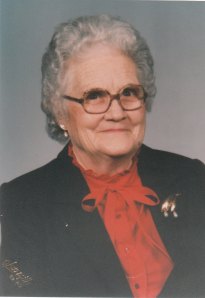
Fronie Bowers JonesI still miss Mother a lot. We made each other crazy when I was growing up, and I got as far away from her as I reasonably could. But I never left for good and I always came back. Following are some excerpts from a story I wrote for a writing class. It wasn’t really a story; it was a list of recollections. So here are some random memories of Mother, for Mother’s Day.
1. Her eyes used to be dark brown, very big. Uncle Hoy said she was the prettiest girl in the community where they grew up, which was Blooming Grove, Tennessee. In her old age, they faded to almost tan-colored.
2. She wore print cotton dresses in cheerful flower patterns. She didn’t wear pants until after Daddy died in 1977, I don’t think.
3. She fell and cracked her kneecap chasing my dog Whitey around the yard when I was 8 or 9. She was trying to throw away sticks blown off the trees by a storm. He kept fetching them back, and she yelled, “You stupid dog!” and chased him with a stick. I laughed and laughed, until she slipped on the wet grass and fell.
4. The only time she ever went to Florida, I took her. I drove from Atlanta in September 1981 and picked her up. We drove to St. Augustine and Daytona Beach. It was the coolest September on record. But she finally saw the ocean, the red and orange sunrises and sunsets, walked in the edge of the surf, and sat in a beach chair on the boardwalk with some other people, who seemed elderly to me. We went to Marineland, and she was too tired to walk from one show to another. That’s when I knew she was sick, not just getting older. She was sick ever after that. Mother must have been about 62 years old.
5. She stayed with me in the hospital for a week when I fractured a vertebra in my back. I was 10 years old, and had been thrown out of a swing when the chain broke on my side–six kids in a porch-type swing in a frame, trying to see how high we could go. I was so bored, because the hospitals didn’t have TVs then (1965?), and she couldn’t drive, so she couldn’t get to the library. She bought me every children’s book in the hospital gift shop, all the ancient paperbacks—Five Little Peppers and How They Grew, Elsie Dinsmore. I read them all. I hated Elsie Dinsmore. What a little priss!
6. When I was in high school, she made a trade with Aunt Eunice Settle (Daddy’s sister). We would can a bushel of Kentucky Wonder beans for her, and Aunt Eunice would slipcover our couch. It took both of us an entire day. Aunt Eunice’s work was done in about three hours. Aunt Eunice always got the best of any bargain going.
7. Mother’s hands were always big and knobby-jointed. She said they were like Papa’s (her father, Herman Bowers), while mine were long-fingered and thin like Mama’s (her mother, Blanche Collier Bowers). Papa and Mama both died before I was born.
8. Mother never learned to drive, ride a bike, or roller-skate. She liked to play Rook, a sort of Southern Baptist card game with no “face cards.” Good Christians didn’t play cards when she was a child.
9. Aunt Elsie was Mother’s best friend from the time they were five years old. One day when they were children Mother had a new dress, a rare occurance, and Aunt Elsie wanted to wear it. They switched dresses on the way to school so Aunt Elsie could wear it. That’s how much Mother loved her, that she would do that. Aunt Elsie was an aunt by marriage. She and Mother married brothers; Mother married George, Aunt Elsie married Jesse. Aunt Elsie’s brother, Uncle Floyd, married Mother’s sister, Aunt Mattie Lou.
The entire “story” is “50 Things About My Mother.” I wrote them in a notebook as I commuted by train to Manhattan. I’m glad I got them written down. Happy Mother’s Day to all my family, friends and readers!

![daddy-and-mother[1]](https://writinghersense.com/wp-content/uploads/2011/11/daddy-and-mother1.jpg) Any of us whose parents live to be elderly are likely to experience their long, sad decline at the end of life. I’ve had both extremes–Daddy died suddenly at a relatively young age, of a heart attack, while Mother spent a couple of decades with heart failure and then strokes. Even when you’ve had lots of time to prepare it always comes as a shock. How can they be gone? How will my life go on?
Any of us whose parents live to be elderly are likely to experience their long, sad decline at the end of life. I’ve had both extremes–Daddy died suddenly at a relatively young age, of a heart attack, while Mother spent a couple of decades with heart failure and then strokes. Even when you’ve had lots of time to prepare it always comes as a shock. How can they be gone? How will my life go on?



![Beautiful_Greek_woman_statue[1]](https://writinghersense.com/wp-content/uploads/2013/06/beautiful_greek_woman_statue1.jpg)


![360px-Kosaciec_bezlistny_Iris_aphylla_RB2[1]](https://writinghersense.com/wp-content/uploads/2013/05/360px-kosaciec_bezlistny_iris_aphylla_rb21.jpg)
 writinghersense