Recipe: Aunt Geneva’s Coconut Pie

Aunt Geneva was my mother’s youngest sister.  She was feisty and funny.  In her young days, she pushed the boundaries of behavior in their country community before World War II.  Aunt Geneva smoked, and drank when she got the chance.  She and their brother, Uncle Jesse (known as Fatty because he was so thin), played harmonica and guitar and sang at parties, which was expressly forbidden by their hard-core Baptist church.   Mother told me it was permissible to sing, but not to play instruments at a “play-party.”  They also were not allowed to play cards except for Rook and Old Maid.

Aunt Geneva was the only one of the sisters to learn to drive a car, work outside the home, and marry someone outside of the community.  She continued to work at a plant that manufactured shoe soles while raising two boys.  I was always happy when she came down to visit Aunt Lou because Uncle Fatty would come over with his guitar, and they would play and sing the old songs, as well as “Little Brown Jug,” “Froggy Went A-Courtin'” and “In the Pines.”

Here is the recipe for Aunt Geneva’s coconut pie.  It is not a coconut cream pie, but a dense, sweet, custard pie, and very easy to make.

Geneva’s Coconut Pie

1 cup sugar

1 cup milk

5 tablespoons flour

dash salt

2 or 3 eggs (2 large, or 3 smaller)

1 teaspoon vanilla

1 can coconut (or 1 cup flaked coconut)

1/2 stick butter

Mix all ingredients.  Bake in unbaked pie shell at 350 degrees about 45 minutes.

Emergency Dessert: Mother’s One Egg Cake

I don’t remember exactly when this photo of my parents was taken, sitting in the swing in the front yard of our house on the farm.  Daddy always wore khaki work clothes to his job at Fort Campbell and also to work around the farm.  Mother thought overalls were low-class, so he never wore them.

Daddy worked hard on the farm, and his job at Fort Campbell in his later years was demanding, too.  I can’t imagine a man in his 50’s unloading frozen sides of beef  and carrying them into the commissary meat locker, but that’s what he did.  Mother felt he needed meat and vegetables every night for dinner, and Daddy felt he needed a dessert as well.

Money was always tight, but we had our own beef and pork, generally one of the yearling calves and one pig that were slaughtered and frozen.  Mother canned and froze vegetables from our garden and apples and pears from various relatives’ trees, and made jams and jellies.  So we always ate well, thanks to her labor (and mine, an unwilling helper!).

The following recipe is the one egg cake she would make when she didn’t have a lot of eggs to spare and not a lot of time.  She generally served it with fruit or ice cream, or made a quick buttercream frosting.  I’ve used  it instead of shortcake with strawberries and whipped cream, or just dusted some powdered sugar on top and called it a day.  It makes a 8″ x 8″ or 9″ x 9″ one-layer cake, just right for four people.

One Egg Cake

2 cups flour

3 1/2 teaspoons baking powder

1/2 teaspoon salt

1 cup sugar

1 egg

1 cup milk

1 teaspoon vanilla flavoring

2-4 tablespoons shortening

Cream together shortening, sugar, egg, vanilla, and milk, then add dry ingredients and mix.  Bake in greased 8″ x 8″ or 9″ x 9″ pan in 350 degree oven (325 degrees if using glass baking dish) for 25 – 30 minutes.  It’s done when lightly browned and center bounces back if you touch it lightly.

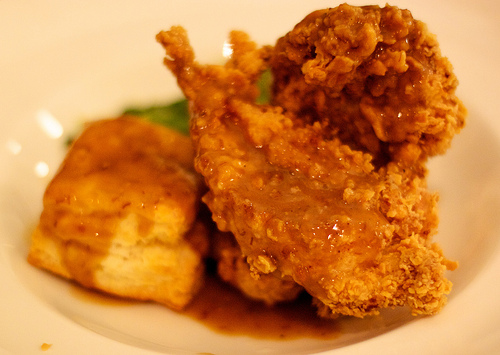
Almost Perfect Fried Chicken

Photo by Niall Kennedy

This recipe comes from my mother’s Sunday School class cookbook, produced about 25 years ago.  It used to make absolutely foolproof, perfect fried chicken.  However, times have changed–and the timing of this recipe needs to change unless you are using a small chicken, what used to be called a “fryer.”  I have discovered that today’s super-sized chickens (I’m talking to you, Frank Perdue, and your son, too) take longer to cook, especially the egregiously oversized breasts.

What follows is the ORIGINAL RECIPE.  If using a larger chicken or pieces, which tend to be thicker, add 2 minutes to each side, and leave the split breasts in for another 5 minutes or more.  Cut into the meat and see if the juices run clear.

So the recipe is not as easy as it used to be.  But it still works, if you use a small freerange-type chicken or adjust the timing.

Sunday School Class Fried Chicken

Clean and cut a whole chicken ready to fry (or buy pieces).  Place in cold water and let set about 3 – 5 minutes.  Pat the pieces dry.  Salt the chicken and roll in flour.  Add a little black pepper if you like.

Meanwhile, heat shortening in a deepish skillet (Crisco is good, or oil, or lard if you’re a purist).  When it’s hot (a drop of water will make the oil sizzle), put the chicken in.  Cook on medium heat 5 minutes with a lid ON the skillet.  Then remove the lid and cook for 4 minutes with the lid OFF.

Turn the chicken pieces and place the top on; cook for 5 minutes.  Then remove top and cook for 4 minutes.  Should be done, crispy but moist inside and not pink.  As noted above, modern breasts and thighs MAY TAKE LONGER!

Fish Recipe: It’s Not All Southern-Fried

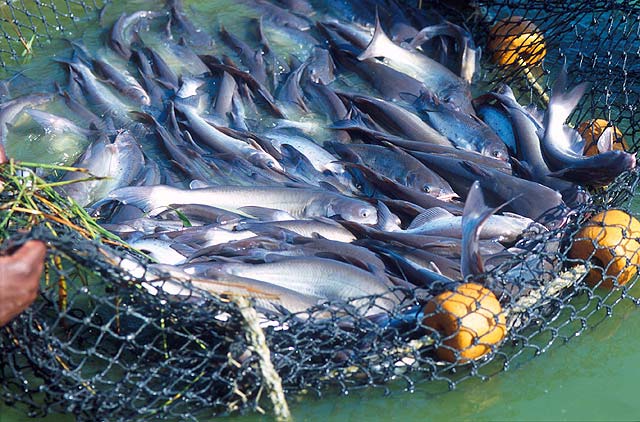
Farmed Catfish, photo by USDA
The fish dinners I grew up with were all fried, sometimes deep-fried filets of bass and sunfish (yum!) and sometimes pan-fried, cornmeal-crusted chunks of catfish, both caught in the Cumberland River by an uncle or a cousin.  Mother always had to hide her chagrin when my cousin showed up with a huge river catfish.  Yes, it was free meat, but catfish are bottom feeders, so a Cumberland River catfish tasted strongly of diesel fuel.

Nowadays I only get fried catfish when I go back to Tennessee to visit.  It’s farm-raised, so the taste is light and fresh.  I learned to love fish over the years prepared a lot of different ways.  Recently I experimented with some fish filets.  The end result was very easy and very good, two of my criteria for cooking.  Here’s the result.

Salsa Verde Fish Filets

1 1/2 lbs. halibut, cod, catfish or other white fish filets

1/4 teaspoon salt

2/3 cup salsa verde or tomatillo sauce (i.e., green salsa)

1/2 cup sliced black olives

3-4 tablespoons chopped fresh cilantro leaves

Fresh ground black pepper to taste

Preheat oven to 350 degrees.  Spray 13″ x 9″ baking dish with vegetable oil or grease with 2 tablespoons olive oil.  Place fish filets in a single layer in the dish.  Sprinkle with salt and top with salsa verde.

Bake uncovered 20 -30 minutes or more until fish is done (flakes easily with a fork).  Garnish with olives and cilantro.

Makes 4 servings.

This is good with rice to soak up the sauce!

Mama’s Tea Cakes

Blanche Ella Collier Bowers

I never knew my grandmother on my mother’s side; she died before I was born.  Mother’s stories about her made her sound like the taskmaster and moral guardian of the family, while Papa, Mother’s father, was fun-loving and mischievous.  Both Mama and Papa worked hard on their small farm all their lives, raising five children.  Mother used to say I had Mama’s hands, long-fingered and slim, while she had Papa’s bony, large-knuckled ones.

Mother learned to cook from Mama, as well as how to can and preserve vegetables and fruits, make jams and jellies, and generally make the most of what they were able to grow in their garden patch.  Most of the recipes were in her head, and Mother did not write them down.  When I was in high school I asked her for Mama’s tea cake recipe.  They are simple, thin cookies, that are in fact good with a cup of tea.  I struggled with these, because it helps to know how to handle biscuit dough without over-working it in order to make these cookies!

Mama’s Tea Cakes

2 1/4 cups sugar

about 2 cups flour

1 tsp. baking soda

pinch salt

2 eggs

2/3 cup buttermilk

1 tsp. vanilla

1 cup butter (or margarine, butter is better)

Preheat oven to 350 degrees.  Mix the dry ingredients and put them on the biscuit board or pastry sheet where you will roll out the cakes.  Make a well in the center of the dry ingredients, and pour the wet ingredients there.  Mix together until you have dough–don’t handle too much!  Roll out thin and cut into round cookies (biscuit cutter or a glass works fine).  Bake until lightly browned.

Optional:  Add lemon zest or orange zest.  Not authentic to the recipe or period, but a nice flavor.

Blackberries, Cobbler, and Ticks

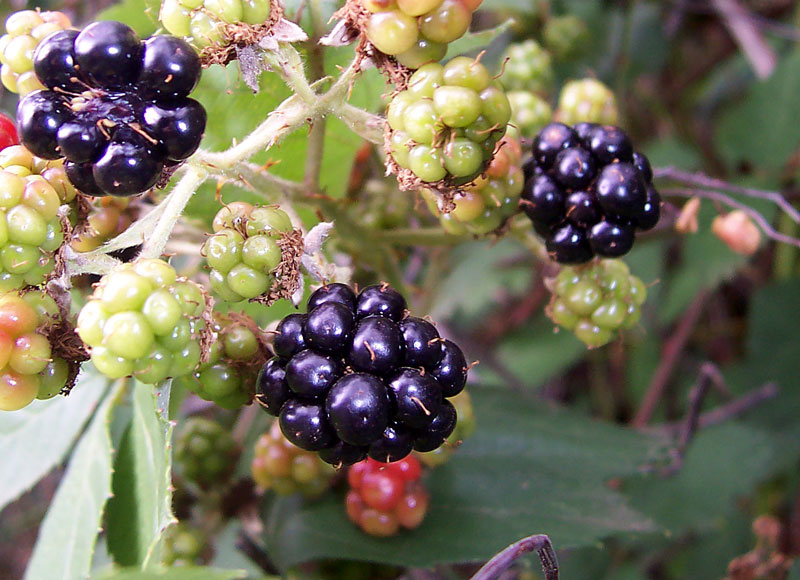
The best blackberries are wild ones, picked in the heat of summer from brambles in a fence row or along the side of an old dirt road.  The wild ones just have more flavor than domesticated ones.  That squirt of purple juice is richer and sweeter than any strawberry.

Photo by Fir 0002
When we lived on the farm Mother and I picked quarts of them every summer.  This was an ordeal.  Mother always carried a stick in case there were snakes, but the real enemies were chiggers and ticks.  We would dress in long sleeves and long pants, socks and shoes, sweating in the heat, in an effort to foil them.  The blackberry bushes were full of thorns and stickers to tear at your hands.  I always emerged with scars.

After filling up as many plastic buckets as we could carry (if the bushes were full), Mother and I trudged back up the hill to the house.  Then the real work began–hunting for the tiny, biting vampires before they got a chance to attach and suck your blood.  The ticks were smaller than deer ticks; I could only see them if they were in motion.  If I missed one, Mother would light a match, blow it out, and touch it to the tick to make it let go.  We checked each other to make sure none got away.  That’s the action referred to in Brad Paisley’s immortal song, “Ticks.”

But the end result of all the blood and labor was blackberry cobbler.  Here is my mother’s easy cobbler recipe.  You can use any fresh or frozen berries, except I don’t recommend strawberries.

Easy Cobbler

Spray bottom of a 9″ x 12″ baking dish (like Pyrex) with Pam or other oil spray.

1 cup flour

1 cup sugar

1/4 tsp. salt

2 tsp. baking powder

3/4 cup milk

1 stick butter or margarine, melted

2 1/2 cups berries, sweetened with 1/2 cup sugar

Mix all dry ingredients in baking dish.  Add milk, stir well.  Pour melted butter over dough.  Place sweetened berries on top.  Bake at 350 degrees until top is brown, 45 minutes to 1 hour.